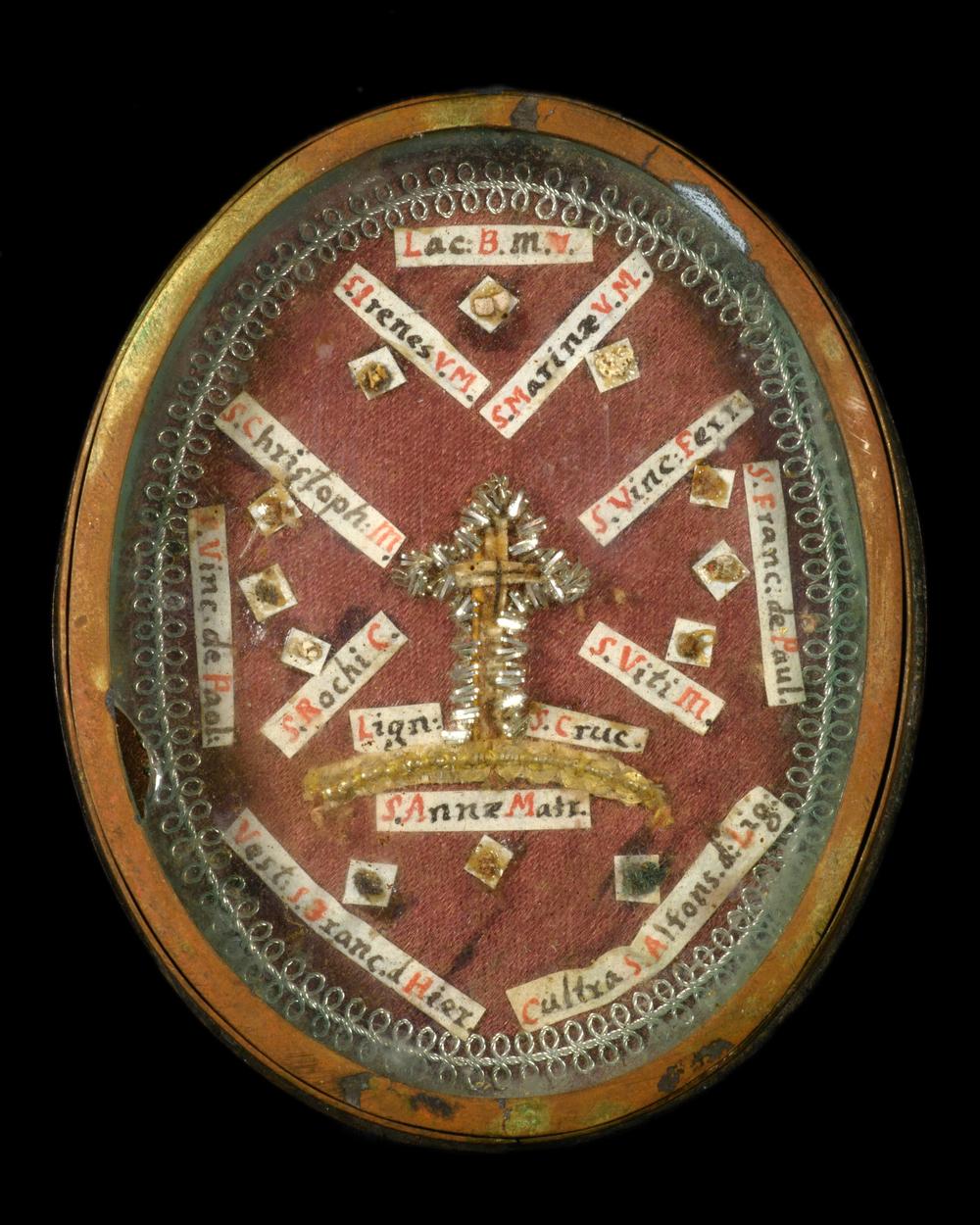
FRANCISCAN RELIQUARY, TRUE CROSS, MILK OF MARY with DOCUMENT
SOLD — This object is now part of a private collection
FRANCISCAN RELIQUARY, TRUE CROSS, MILK OF MARY with DOCUMENT
Our prices are in euros, the prices converted in dollars or other currencies can vary according to the rate.
Free shipping – fast and secure delivery.
ref: #RK00-885Couldn't load pickup availability
Rare oval reliquary in bronze, glazed at the front, containing several notable relics, carefully arranged on a red silk ground, a color omnipresent in Christian liturgy, symbolizing the Blood of Christ and His redemptive sacrifice.
The old handwritten labels identifying the holy relics can be clearly distinguished:
Lign. SS. Cruc. – Wood of the True Cross
Precious fragment of the wood upon which Christ was crucified. Spiritual center of the reliquary, presented in the form of a radiant cross.
Lac. B. M. V. – Milk of the Blessed Virgin Mary
Relic of exceptional rarity: particles of the milk of the Holy Virgin, preserved and venerated for centuries. A precious testimony of Marian devotion, symbol of spiritual motherhood and protection.
S. Anne Matr. – Saint Anne, Mother of the Virgin
Mother of Mary and grandmother of Jesus, honored since the earliest times of Christianity. Her figure embodies transmission, gentleness, and the roots of faith.
S. Viti. M. – Saint Vitus ( Saint Guy ), martyr
Young martyr whose cult is ancient and popular, invoked against nervous illnesses and disorders. His presence in a reliquary underscores both physical and spiritual protection.
S. Christoph. M. – Saint Christopher, martyr
The great bearer of Christ, protector of travelers and pilgrims, symbol of passage and strength. His cult is among the most widespread in Europe.
S. Iren. V. M. – Saint Irene, virgin and martyr
Model of chastity and fidelity, witness to an uncompromising faith. Her name evokes the serene victory of the soul over persecution.
S. Marinae V.M. – Saint Marina, virgin and martyr
Young martyr whose purity and courage are venerated in both Eastern and Latin traditions. Her presence recalls the steadfastness of the first Christian women in trial.
S. Vinc: Ferr. – Saint Vincent Ferrer
Spanish Dominican, great preacher and wonderworker († 1419). Tireless apostle, invoked for the conversion of hearts and the peace of souls.
S. Franc. de Paul – Saint Francis of Paola
Eremitical founder of the Minims († 1507), man of miracles and rigorous asceticism. Patron of sailors, model of joyful solitude and austere charity.
S. Vinc de Paoli – Saint Vincent de Paul
Founder of modern charitable works, apostle of the poor and abandoned. His name remains associated with active and practical compassion.
S. Rochi. C. – Saint Roch, confessor
Protector against plague and epidemics, recognizable by his staff and dog. Symbol of intercession and aid in sickness.
Cultra S. Alfons. d: lig: – Saint Alphonsus Liguori
Founder of the Redemptorists († 1787), Doctor of the Church, master of moral theology and compassion. His cult remains very much alive in Catholic countries.
Vest: S. Franc. d Hier – Garment relic of Saint Francis of Assisi
Textile fragment linked to the habit of the Poverello of Assisi, material witness to a life of evangelical poverty and mystical fervor.
The ensemble is harmoniously arranged around the central Cross, beneath its original glass. On the reverse, the red wax seal of a Franciscan guardian and the original silk threads, perfectly preserved.
The reliquary is accompanied by an original authentic document issued in 1850 by Brother Elias, a Franciscan of the Observance, attesting to the authenticity of the relics it contains.
“I testify, I the undersigned, Brother Elias of Sobas, of the Order of Friars Minor, of Capriano and guardian of the venerable convent of Saint Francis of Capriano, that from authentic places I have received the following eleven sacred relics:
namely: particles of the wood of the Holy Cross of Our Lord Jesus Christ; from the stone upon which the Blessed Virgin Mary fell, commonly called ‘Latte della Vergine’; bones of Saint Anne, mother of the Blessed Virgin Mary; of Saint Vitus, martyr; of Saint Christopher, martyr; of Saint Irene, virgin and martyr; of Saint Marina, virgin and martyr; of Saint Vincent Ferrer; of Saint Francis of Paola; of Saint Vincent de Paul; of Saint Roch, confessor; of Saint Alphonsus Liguori, from his cult; and of the garment of Saint Francis of Hyerosimo, confessor.
All these I have piously placed within a reliquary of oval form, fitted with a single crystal at the front, firmly bound with a red silk thread, and marked for their identity with the seal impressed in red wax of my office, for the greater glory of God and the veneration of the aforesaid relics.
In witness whereof.
Given at the convent of Saint Francis of Capriano, March 13, in the Jubilee Year 1850.
Brother Elias of Sobas, Guardian of Capriano.”
Note: a small chip on the glass at the edge.
Originally constituted as complex devotional ensembles intended for conventual or institutional use, these composite reliquaries — whose historical rarity lies in the strict supervision of their collection and authentication — are today encountered only exceptionally on the international specialized market, most often originating from old private or religious collections that have remained intact.
PERIOD : 1850
DIMENSIONS : 8.5 × 7 cm
SIZE : 3.4" × 2.8"
A Jubilee Year is a solemn year of grace instituted by the Catholic Church to invite the faithful to penance, pilgrimages, and the reception of indulgences. Its origin lies in the prescriptions of the Old Testament, where every fifty years the jubilee restored liberty, cancelled debts, and returned land to its owners. The first Christian jubilee was proclaimed in 1300 by Boniface VIII, and after several adjustments the regular interval was fixed at twenty-five years so that each generation might experience one. The jubilee was marked above all in Rome by the opening of the Holy Doors and the influx of pilgrims from all over the world. For several centuries this practice unfolded regularly, and ordinary jubilees punctuated the spiritual life of the Church.
Only in the 19th century was this continuity broken: 1800 was not celebrated because of the Napoleonic wars, the Church being caught in a context of conflict and occupation. The jubilee of 1850, to which our certificate is linked, was itself hindered by the political troubles following the Roman Republic and the exile of the Pope. However, even if the great public ceremonies were limited, the year had been officially proclaimed a jubilee by Pius IX and retained its full spiritual value. The faithful could obtain indulgences, religious continued to mention it, and ecclesiastical acts remained dated “in the Jubilee Year.” It was within this framework that Brother Elias wrote his certificate at the convent of Saint Francis of Capriano: he inscribed his act within the liturgical time of the jubilee despite external circumstances preventing Rome from celebrating with splendor. That of 1875, though proclaimed, took place without pomp or public ceremonies: Rome had just been annexed to the Kingdom of Italy and the Pope, withdrawn within the Vatican, would celebrate nothing outside his jurisdiction.
The tradition truly resumed its course only with the jubilee of 1900, under Leo XIII, which marked the return of great celebrations and the influx of pilgrims. Since then, jubilees have followed one another regularly every twenty-five years, and this tradition continues today, each generation thus having the opportunity to live a year of grace in the spirit of the medieval jubilees.