

Among the twelve apostles of Christ, Saint Thomas holds a singular place. Neither a charismatic leader like Peter nor a visionary mystic like John, he is the one whose faith passes through doubt, the one who wants to see in order to believe.
His very name, Thomas, derives from the Aramaic T’om’a — rendered in Greek as Didymos, “the twin.” This nickname is not only biological; it also reflects the spiritual duality of the man: torn between faith and reason, between fear and the heart’s impulse.
But beyond the reductive image of the “doubting Thomas,” Christian tradition sees in him a pioneer of reflective faith, a missionary apostle who carried the Gospel to the ends of India, and a symbol of the inner journey that leads from doubt to absolute certainty: that of the risen Christ.

Relic of Saint Thomas on the Relics.es website
Thomas in the Gospels
The Synoptic Gospels say little about Thomas, but the Gospel according to John gives him a remarkable place. There his complex personality emerges, made of passionate loyalty and searching intelligence.
Loyal courage
The first words John reports occur at the raising of Lazarus.
Jesus decides to return to Judea at the risk of his life, and the disciples are anxious. It is Thomas who declares:
“Let us also go, that we may die with him.” (Jn 11:16)
This sentence, often overlooked, shows a Thomas clear-eyed about danger yet deeply faithful. His courage does not come from blind rashness but from fidelity without calculation.
He is not the ironic skeptic we imagine; he is first of all a man of tragic fidelity, ready to follow his Master anywhere, even to death.
The questioning disciple
At the Last Supper, Jesus speaks to his disciples about the mystery of his departure:
“Where I am going, you know the way.”
And Thomas, with disarming frankness, replies:
“Lord, we do not know where you are going; how can we know the way?” (Jn 14:5)
This question opens the way to one of Christ’s highest revelations:
“I am the way, the truth, and the life.”
Without Thomas’s frankness, this foundational saying might not have been spoken.
Thus, Thomas’s doubt is not rebellion; it is the sincere quest of a mind that seeks to understand before assenting.
Witness of the Risen One
Finally, after the Resurrection Thomas truly enters the spiritual history of humanity.
Absent at Christ’s first appearance to the apostles, he refuses to believe their words:
“Unless I see in his hands the mark of the nails, and put my finger into the nail marks and put my hand into his side, I will not believe.” (Jn 20:25)
Eight days later, Jesus returns. He addresses Thomas directly, as if he had heard his cry:
“Put your finger here and see my hands; bring your hand and put it into my side. Do not be unbelieving, but believe.”
Thomas collapses, overwhelmed, and utters one of the deepest professions of faith in the New Testament:
“My Lord and my God!” (Jn 20:28)
This confession surpasses all the others: it acknowledges not only Christ’s lordship but also his divinity.
Thus, Thomas’s doubt becomes the source of a higher faith, grounded in personal encounter rather than hearsay.
The spiritual meaning of Thomas’s doubt
Doubt as a passage
In Christian tradition, Thomas’s doubt is not condemned.
He embodies the inner tension of every believer between received faith and tested faith.
Saint Gregory the Great sums it up magnificently:
“The doubt of Thomas has done more for faith than the faith of the other disciples, for by touching the wounds of the Master he healed in us the wound of doubt.”
Doubt is therefore not negative: it becomes a divine pedagogy, allowing faith to be grounded not in emotion or fear, but in experienced truth.
An incarnate faith
By insisting on touching the wounds, Thomas manifests an incarnate faith: he wants to believe in a truly risen God, not an abstraction.
His gesture symbolizes Christianity itself: a carnal faith, where mind and senses cooperate to grasp the mystery.
In Christian art, this gesture becomes a central motif: the “Finger of Thomas” touching Christ’s side.
This scene, painted notably by Caravaggio, condenses the tension between flesh and glory: a contact point between the visible and the invisible.
Thomas’s apostolic mission
After Pentecost, tradition relates that Thomas received as his field of mission the lands of the East.
The apocryphal Acts of Thomas, composed in the third century, describe his journey and martyrdom, blending symbolic narrative and historical memory.
Thomas in Persia and India
According to Syriac and Indian traditions, Thomas first preached in Parthia (present-day Iran), then reached the Malabar Coast in southwest India.
The Christians of Saint Thomas, still present today in Kerala, claim direct descent from his apostolate.
They maintain that he founded seven communities, erected stone crosses, and baptized many local families.
Even if the historical sources are late, the unanimity of this tradition in the Eastern Churches (Syriac, Indian, Chaldean) shows that the memory of Thomas the missionary was deeply rooted from the earliest centuries.
The martyrdom
Thomas is said to have been martyred at Mylapore (near Madras) around the year 72, pierced by lances while praying.
His relics were transferred to Edessa (Mesopotamia) in the third century, where a great shrine was dedicated to him.
In the Middle Ages, some relics were brought to Ortona, Italy, where they are still venerated today.
Thomas in the Eastern tradition
In Eastern Christianity, Saint Thomas holds an essential place.
The Syriac and Malabar Churches regard him as their founder and protector.
The spiritual twin of Christ
The nickname Didymos (the twin) has been interpreted mystically: Thomas is the “spiritual twin of Christ,” not by flesh but by his call to share Christ’s Passion and Resurrection.
In certain gnostic apocrypha, Thomas is even described as the disciple initiated into the inner mystery, receiving secret revelations from the Lord.
Without endorsing these writings, the Church has retained the idea that Thomas symbolizes the believer called to a personal faith born of encounter.
Bearer of light in the East
In the Syriac liturgy, Thomas is celebrated as “the Apostle of India” and “the sun of the East.”
His mission to India is understood not merely as a geographical venture but as a mystical bridge between West and East, between reason and contemplation.
Thus, Thomas’s doubt becomes the engine of a universal quest: the search for Truth that enlightens all peoples.
The cult and representations of Saint Thomas
Liturgical cult
The feast of Saint Thomas the Apostle is celebrated on July 3 (the date of the translation of his relics to Edessa).
In the older calendar it appeared on December 21, recalling his role in faith in the Incarnation.
The Catholic Church venerates him as patron of architects, masons, and surveyors (due to apocryphal traditions in which he builds a palace for an Indian king).
He is also the patron of theologians and seekers, a symbol of a faith unafraid to ask questions.
In art
Since the Middle Ages, Saint Thomas is recognizable by his attributes: a square (symbol of building) or a lance, the instrument of his martyrdom.
But the most famous image remains that of the Doubting Thomas, immortalized by Caravaggio around 1601:
Thomas is shown placing his finger into Christ’s wound, under Jesus’s calm and grave gaze.
This scene is not a rebuke but an initiation, in which Christ consents to be touched so that faith may become certainty.
The theology of doubt and faith
Thomas, a modern figure
Saint Thomas particularly fascinates modern believers, for whom faith is no longer an automatic inheritance but an inner journey.
He embodies the tension between reason and mystery, between the need for evidence and the call of the heart.
His spiritual path reminds us that doubt is not the enemy of faith but often its threshold.
As Cardinal Newman said:
“To doubt is not to sin, if doubt leads one to seek the truth.”
An embodied faith
For Thomas, faith is not abstract: it proceeds through touch, through the flesh.
In this he anticipates Christian realism: divine truth offers itself to humanity in the concreteness of the body and suffering.
To touch the wounds is to touch Christ’s humanity and to recognize in it the glory of God.
Faith thus becomes not an escape into the spiritual but an adherence to transfigured reality.
From sight to vision
Jesus says to him:
“Because you have seen me, you believe. Blessed are those who have not seen and yet have believed.”
This sentence does not condemn Thomas but opens the beatitude of faith to all who will come after.
Thomas is the last disciple to see the visible Christ; after him, faith becomes the place of an invisible yet real contact.
In a sense, Thomas closes the era of eyewitness testimony to inaugurate that of spiritual testimony.
The message of Saint Thomas today
A figure for a skeptical world
In a world where faith is often seen as naïveté, Saint Thomas reminds us that Christian faith stands up to examination.
Christ does not reject his demand for proof; he answers it.
Thus sincere doubt—the kind that seeks truth rather than escape—becomes a stage of mature faith.
Thomas is the patron saint of seekers of meaning, of those who struggle to believe yet refuse to settle for nothingness.
His cry—“My Lord and my God!”—remains the prayer of all hearts torn between reason and mystery.
The realism of the Resurrection
Thomas’s gesture reminds us that the Resurrection is not a metaphor: the body of the risen Christ bears the marks of his Passion.
Christian faith does not erase suffering; it transfigures it.
By touching the wounds, Thomas touches both pain and glory.
His faith is an embodied, not idealized, faith: a faith that sees light through wounded flesh.
The universality of his mission
Finally, his apostolate to India makes Thomas the apostle of the whole world.
His journey East symbolizes Christianity’s expansion toward non-Western cultures.
He links Jerusalem to Madras, Rome to Kerala: the message of Christ knows no borders.
In an age of interreligious dialogue, Thomas remains the messenger of encounter.
Relics of Saint Thomas

Reliquary containing the relics of Saint Thomas in the Basilica of San Tommaso Apostolo, Ortona, Italy
Some of Saint Thomas’s relics are still in Chennai, India, near the place where he died and was buried. Others ended up on the Greek island of Chios in the early thirteenth century, where Saint Thomas’s skull is said to remain. Still others made their way to Italy in 1258, when the general of Ortona, Leone Acciaiuoli, visited the Greek island with three galleys and had a spiritual experience.
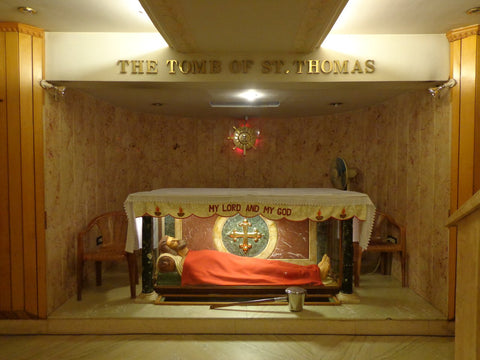
The tomb of Saint Thomas, Chennai, Tamil Nadu, India.
After successfully plundering the place, the general went to the local church to pray. According to legend, a gentle hand made two signs to him, asking him to approach, and he felt a sweetness and peace like never before. Acciaiuoli then approached the tomb and took a bone. A halo surrounding the bones proved to him that he had indeed found the relics of the Apostle Saint Thomas. The next night he returned and stole the rest of the relics and the tomb itself.
In 1358 the relics were brought to the local church of Ortona, later raised to the rank of minor basilica by Pope Pius IX in 1859. There the relics of the Apostle Saint Thomas, together with the plundered tombstone, were displayed in a crypt and have remained there to this day.

Finger relic of Saint Thomas, part of the collection kept at the Basilica of the Holy Cross in Jerusalem (Santa Croce in Gerusalemme), Rome.
The relics survived centuries of turmoil—a quake, a Turkish attack, a fire, a French attack—yet remained intact. Later they were placed beneath the church altar. The church was damaged again during the Second World War under German occupation. A heavy silver bust of Saint Thomas was hidden from the Germans in a dark corner under wood, and the relics—seeing daylight for the first time in 150 years—were hidden in the priest’s house.
When the church reopened after renovation and rebuilding in 1949, the tomb and the relics of the Apostle Saint Thomas, preserved in a gilded-copper shrine, were placed in a crypt of the basilica, where they remain today. The bust of Saint Thomas, which contains some fragments of his cranial bone, is again on display in the church. Today many people visit the Basilica of San Tommaso on the 195-mile “Cammino di San Tommaso,” the Route of Saint Thomas, from Rome to Ortona.
Another arm bone of Thomas is in a reliquary at the church of Saint Nicholas of Bari, Italy. The Cronicon Bari records that a French bishop, cousin of Baldwin of Bourcq, lord of Edessa, returning in 1102 from the Holy Land and Edessa, left the relic of Saint Thomas the Apostle in Bari’s basilica; the reliquary itself dates to 1602–1618, shaped like a right arm holding a lance (recalling the Apostle’s martyrdom), and rests on a base containing a relic of Magdalene. Thomas’s bone is visible through a window in the reliquary. In 2009 the bone was measured and compared with those in Ortona. The upper-arm bone measures 23 cm; this can be used to calculate total body length at 163.4 cm ± 2 cm, about the same as the Ortona skeleton. The right upper arm missing at Ortona could therefore be the same person’s bone.

Another arm bone of Thomas is in Maastricht, the Netherlands, in the treasury of the Basilica of Saint Servatius. Curiously, the treasury label mentions it as the right-arm bone of Saint Catherine, but the text visible through the reliquary window clearly reads: Saint Thomas Apostle. It may be the missing right-arm bone from the Ortona skeleton.
Moreover, some finger bones are missing at Ortona. The index finger of “doubting” Saint Thomas—the finger that touched Christ’s wound—is kept at the Basilica of Santa Croce in Gerusalemme in Rome. Some say this relic has been at Santa Croce since the time of Saint Helena (third–fourth century, when the body was transferred to Edessa). At the center of the reliquary, remade after the French Revolution, is an oval case with crystal on both sides, inside which sits a finger-shaped support with two openings on the side. Through the openings, the finger bone is clearly visible. Other finger pieces of Thomas returned from Edessa to India (rather than to Europe). A reliquary with several hand bones is preserved at the Saint Thomas Museum of Mylapore.
David, A. (1994). Saint Thomas and the Spread of Christianity in India. Catholic Historical Review, 80(3), 365–380.
Horsley, R. A. (2008). The Journey of Saint Thomas: From India to Italy. Journal of Early Christian Studies, 16(2), 187–203.
Sweeney, R. (2007). The Relics of Saint Thomas the Apostle: A Historical and Archaeological Review. Studies in Christian Antiquity, 12(1), 45–64.
Topping, L. (2002). Saint Thomas: The Apostle’s Journey Through Time. Ortona Historical Society Publications.
Smith, J. (2010). Saint Thomas in Ortona: A Study of the Relics and Their History. Italy and the Holy Land, 9(4), 303–320.
Brown, M. (2015). The Relics of Saint Thomas: From India to Europe. Journal of Medieval History, 41(2), 114–130.
Keller, J. (2012). The Relics of Saint Thomas: A Pilgrim’s Guide to the Sites. Pilgrimage Studies Journal, 6(3), 76–89.
Bianchi, F. (2000). Saint Thomas the Apostle: The Relics and the Traditions. Basilica Studies Quarterly, 7(2), 157–174.