PAIR OF 18TH-CENTURY ITALIAN RELIQUARIES WITH GRIFFINS
PAIR OF 18TH-CENTURY ITALIAN RELIQUARIES WITH GRIFFINS
Our prices are in euros, the prices converted in dollars or other currencies can vary according to the rate.
Free shipping – fast and secure delivery.
ref: #RK00-921Couldn't load pickup availability
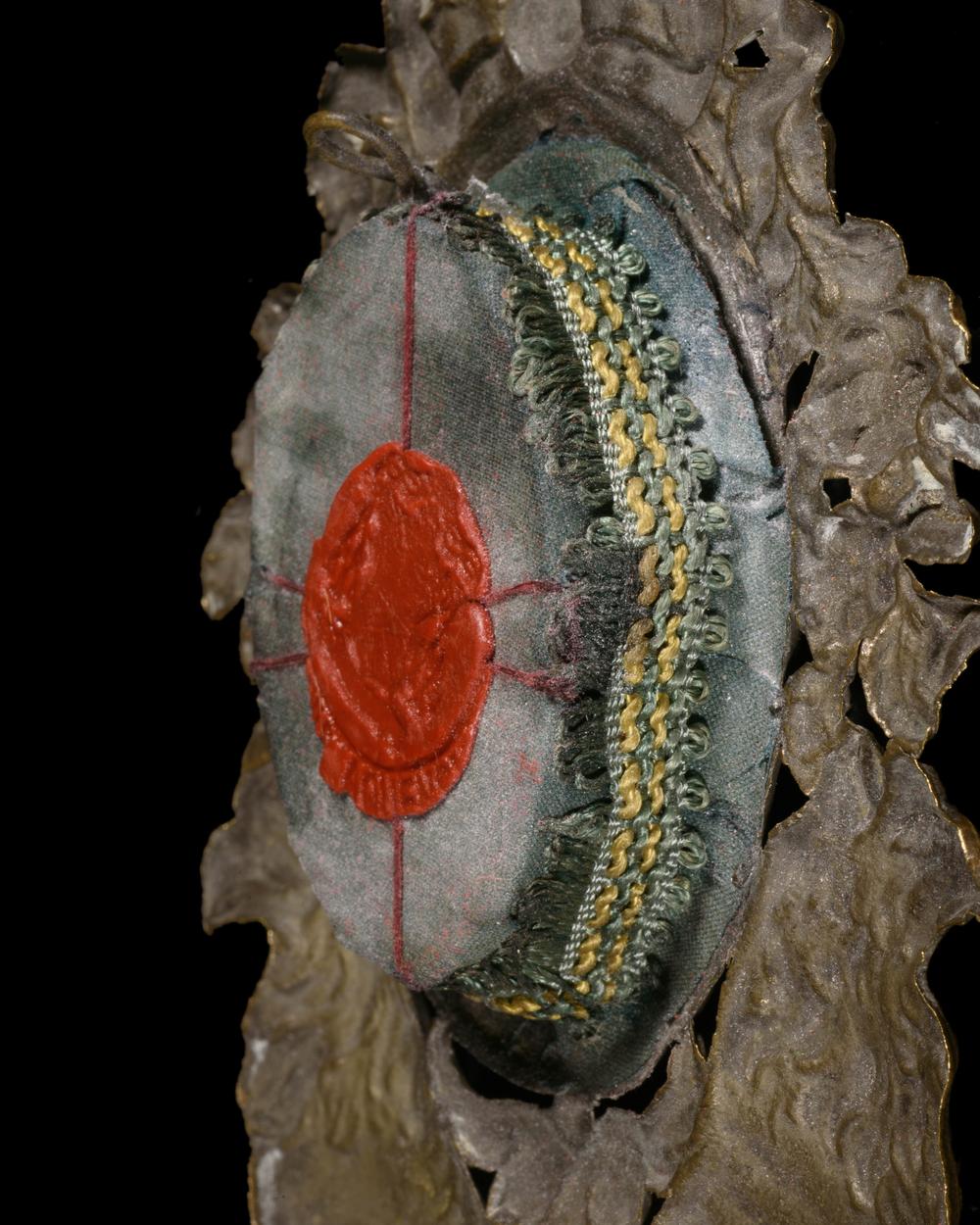
Superb and rare pair of 18th-century Italian reliquaries, originating from northern Italy, more precisely from the Piedmont-Liguria region (Acqui area).
These pieces display remarkable repoussé brass work, finely chased, characteristic of late Baroque production in northern Italy. The frame, richly adorned with vegetal scrollwork, reflects a decorative vocabulary still full of movement and vitality, typical of the 18th century. It is surmounted by an elegant ornamental bow, a motif both decorative and symbolic, evoking the union between the earthly world and the celestial sphere.
The base adopts a particularly expressive form with a pair of confronting griffins, hybrid figures half eagle, half lion, traditionally associated with vigilance, the guarding of treasures, and the protection of the sacred. Their presence here is not incidental: they frame and “watch over” the relics, reinforcing the apotropaic dimension of the object.
At the center, an oval glazed medallion (original antique glass) houses a delicate arrangement of relics, symmetrically organized around an internal silver cross. The interior, of great refinement, reveals a deep red textile background, enhanced with finely hand-embroidered flowers and antique trimmings, testifying to refined craftsmanship and a decorative taste typical of the 18th century.
This red hue, far from being incidental, carries strong symbolic meaning: in Christian tradition, it evokes the blood of Christ, a reminder of the redemptive sacrifice and the Passion. It also echoes the martyrdom of the saints whose relics are preserved here, thus establishing a direct link between sacred matter and the mystery of faith.
The background thus acts as a true spiritual field, intensifying the presence of the relics and structuring the composition with great subtlety. The whole reveals a remarkable balance between decorative richness, symbolic depth, and artisanal mastery, characteristic of the finest devotional objects of the 18th century.
Each reliquary contains four relics, making a total of eight relics identified by their original labels.
Reliquary No. 1
- S. Evaristo — Saint Evaristus
Pope of the early centuries (2nd century), figure of the early Church. - S. Cecilia — Saint Cecilia
Roman virgin and martyr, patron saint of sacred music. - S. Felice — Saint Felix
Martyr of the early centuries, symbol of fidelity in faith. - S. Clemente — Saint Clement
Pope and martyr, direct successor of Saint Peter.
Reliquary No. 2
- S. Lodovico — Saint Louis (probably Louis of Toulouse)
Prince who became a Franciscan, son of the King of Naples, who renounced the throne to become a bishop and religious. - S. Chiara — Saint Clare
Founder of the Poor Clares, major figure of Franciscan spirituality. - S. Filippo — Saint Philip
Apostle of Christ, direct witness of the Gospel. - S. Rosa — Saint Rose
Mystical saint associated with purity and devotion.
Ecclesiastical seals and silk threads present.
PERIOD : 18th century
DIMENSIONS : 14 cm × 10.5 cm
SIZE : 5.5" × 4.1"
In Western iconography, the griffin holds a singular place as a protective figure inherited from ancient traditions. Present as early as the Greco-Oriental world, where it is associated with the guarding of precious treasures — notably gold and sacred goods — it has traversed the centuries while maintaining this function of vigilance. Its hybrid nature, combining the body of a lion, symbol of earthly power and sovereignty, with the head and wings of an eagle, emblems of elevation and celestial dominion, grants it a particular dimension: that of a being capable of linking two realms, the material world and the higher sphere.
This ambivalence explains its gradual adoption into Christian iconography, where it integrates seamlessly into a symbolic system based on the spiritual reading of forms. The griffin becomes a guardian figure, often placed near elements considered sacred or precious. In the context of reliquaries, this function takes on its full meaning: relics, perceived as material traces of holiness and direct witnesses of the divine, are regarded as true spiritual treasures. Their preservation therefore calls for a visual language capable of expressing both their value and the necessity of their protection.
The griffin responds precisely to this requirement. Its presence, whether discreet or more pronounced, conveys the idea of constant vigilance and respect for the sacred. Through its dual nature, it also evokes the inherent tension within relics themselves, material objects that carry a spiritual reality. In this sense, it is not merely a decorative motif, but a fully meaningful element, contributing to a coherent conception deeply rooted in the religious and artistic culture of the West.
Thus, the use of the griffin in the ornamentation of reliquaries is part of a symbolic continuity in which ancient heritage and Christian thought converge, giving this figure a lasting relevance in the representation and enhancement of the sacred.