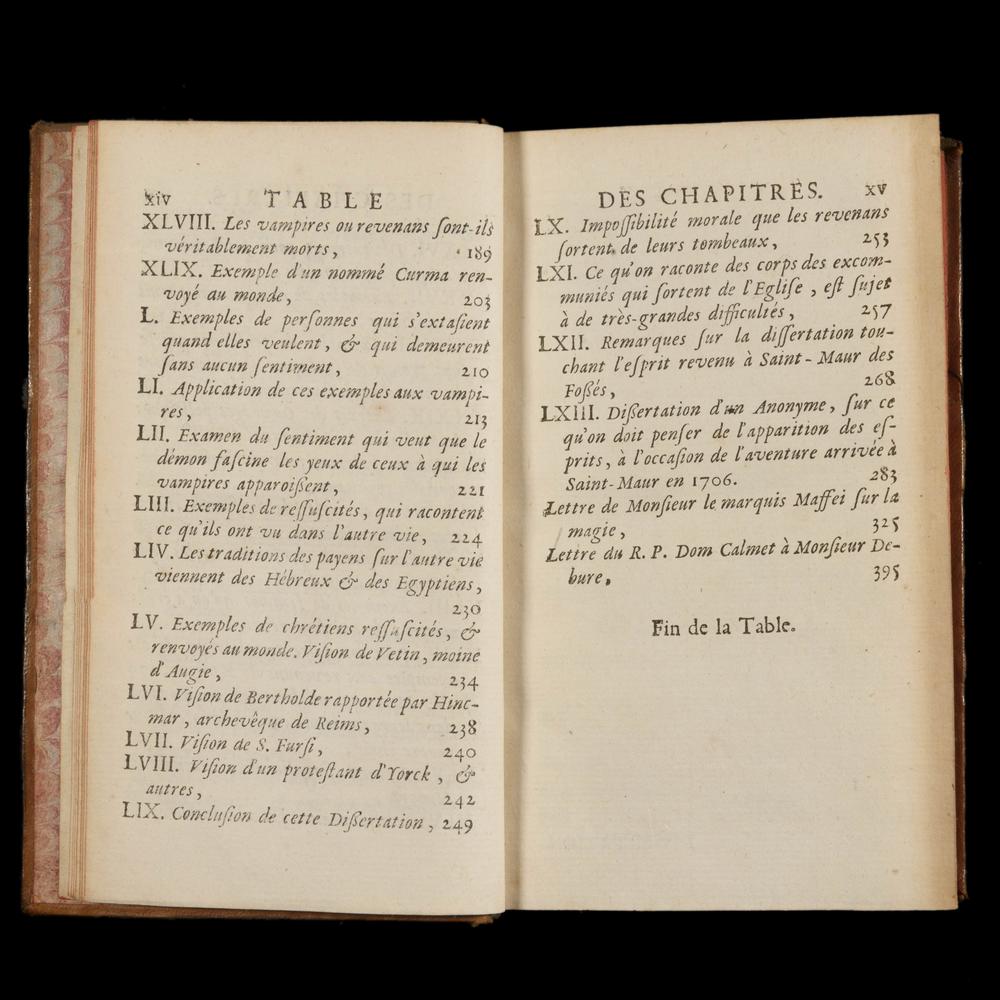
TREATISE ON VAMPIRES, 1759
SOLD — This object is now part of a private collection
TREATISE ON VAMPIRES, 1759
Our prices are in euros, the prices converted in dollars or other currencies can vary according to the rate.
Free shipping – fast and secure delivery.
ref: #RK00-971Couldn't load pickup availability
One of the First Great Treatises on Vampires
Senones, 1759 – Complete Edition in Two Volumes
Apparitions, Revenants and Vampires
The Book that Introduced Vampires into European Scholarly History
Published in Senones in 1759, the Traité sur les apparitions des anges, des démons, des esprits et sur les revenants et vampires de Hongrie, de Bohême, de Moravie et de Silésie is now regarded as one of the founding works of European vampire literature. Long before Dracula and long before the Gothic fiction of the nineteenth century, this book collected, examined, and discussed the accounts that gave birth to the modern vampire myth.
The author, Dom Augustin Calmet, was neither an occultist, a fringe demonologist, nor a writer of fantastic tales. A Benedictine abbot of the Abbey of Senones, a scholar respected throughout Europe, and a correspondent of the greatest intellectuals of his age, he undertook a methodical study of a phenomenon that troubled the civil, military, and religious authorities of Eastern Europe.
At the beginning of the eighteenth century, official reports from Hungary, Serbia, Bohemia, Moravia, and Silesia described the dead allegedly leaving their graves to torment the living. These accounts were numerous, detailed, and sometimes documented by imperial officers, magistrates, or clergymen. Exhumed corpses were described as astonishingly well preserved, with flushed faces, flexible limbs, and blood around the mouth. They were said to visit their relatives at night, suffocate them in their sleep, or gradually drain their strength until death.
It was in this context that the word “vampire” entered Western culture.
Dom Calmet’s treatise represents one of the earliest serious attempts to gather together all of these cases. The work presents the famous vampire incidents of Hungary and Serbia that fascinated Enlightenment Europe. It reproduces testimonies, investigations, administrative reports, and medical observations while confronting these accounts with Catholic theology, history, and critical reason.
The reader discovers a world in which the boundary between life and death appears uncertain. The revenants are described not as literary creatures, but as phenomena regarded as real by entire populations. Exhumations, decapitations, impalements, and cremations intended to end vampiric attacks appear in the book as practical responses to a threat considered genuine.
This aspect is essential. The vampire portrayed by Dom Calmet is not yet the romantic seducer of the nineteenth century. He is a restless dead man, a nocturnal presence, a feared being born of the folk beliefs of Central Europe. The treatise thus preserves the earliest and most authentic form of European vampirism before its transformation into a literary figure.
The Senones edition occupies a special place in the history of the text. It is sought after as the most complete edition, notably including the famous letter of the Marquis de Maffei on magic, absent from some earlier printings. It represents the culmination of Dom Calmet’s work on a subject that generated considerable controversy throughout learned Europe.
Beyond vampirism, the work also examines ghostly apparitions, demonic manifestations, possessions, revenants, and supernatural phenomena reported in ancient chronicles. It therefore offers an exceptional overview of beliefs concerning the dead and the invisible world in eighteenth-century Europe.
More than two and a half centuries after its publication, this book remains one of the definitive references for the history of the vampire. It is not only a monument of Enlightenment religious scholarship, but also one of the most important texts ever devoted to revenants and vampirism. Few works can claim such a profound influence on the Western imagination of the undead.
Condition and Bibliographical Description
Senones edition, 1759, in two duodecimo volumes. This edition is particularly sought after as the most complete, including the Marquis de Maffei’s letter on magic. Contemporary uniform full marbled calf bindings, spines with five raised bands. Red-dyed page edges. An attractive and homogeneous set preserved in its original bindings.
Format: 2 duodecimo volumes
Pagination: XXIV–422 pp.; XV–402 pp.
Dimensions: approx. 17 × 10 cm
Size: approx. 6.7" × 4"
Language: French
Date: 1759
Binding: Contemporary full marbled calf, spine with 5 raised bands, red edges
In the eighteenth century, the vampire was not yet the aristocratic and seductive figure later popularized by Romantic literature. In the rural regions of Hungary, Serbia, Bohemia, and Moravia, it was regarded as a dead person returning from the grave to torment the living. Reports described unexplained deaths, sudden illnesses, and nocturnal visitations attributed to recently buried individuals. When graves were opened, some bodies were found astonishingly well preserved, with fresh complexions and traces of blood around the mouth—signs interpreted as proof of activity after death. These incidents aroused such concern that official investigations were conducted by civil, military, and religious authorities. Throughout Enlightenment Europe, the phenomenon sparked a major debate between advocates of supernatural explanations and defenders of rational inquiry. It was in this context that the vampire left local folklore and entered learned literature, becoming both a subject of study and an object of fascination. Dom Calmet was among the first scholars to gather and analyze these accounts, which would ultimately give rise to the modern vampire myth.