TRAVEL RELIQUARY OF THE TRUE CROSS AND THE HOLY THORN
SOLD — This object is now part of a private collection
TRAVEL RELIQUARY OF THE TRUE CROSS AND THE HOLY THORN
Our prices are in euros, the prices converted in dollars or other currencies can vary according to the rate.
Free shipping – fast and secure delivery.
ref: #RK00-932Couldn't load pickup availability
Travel Reliquary of the True Cross and the Holy Thorn – 18th Century
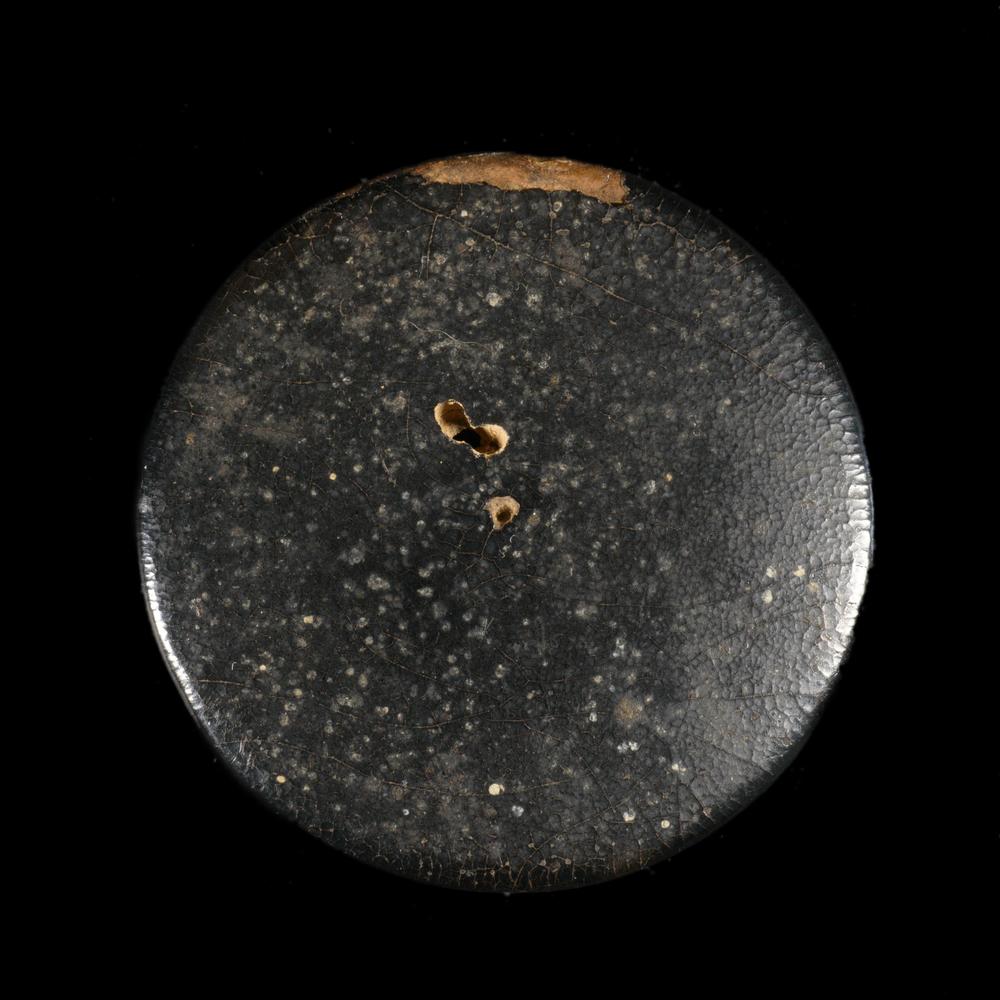
Rare 18th-century travel reliquary, preserved in its original circular case of blackened wood with a removable lid.
Beneath its original glass, it displays a delicate composition of gilded paperolles, meticulously rolled and arranged into spirals, floral motifs and radiating ornaments surrounding a small central cross.
The reliquary contains two relics of the Passion of Christ: a fragment of the True Cross and a relic of the Holy Thorn. They are accompanied by their original small labels bearing the French inscriptions “Vraie Croix” and “Ste Épine”.
The relic of the True Cross is positioned at the centre of the composition, upon the small cross, while the Holy Thorn is placed in the lower section. The whole is framed by remarkable gilded paperolle work, creating a particularly rich decorative effect despite the small dimensions of the object.
The compact form of the reliquary and its protective blackened wooden case attest to its function as a travel reliquary, designed to allow these precious relics to be carried and used for private devotion.
The object retains a fine degree of authenticity, with its original glass, period interior decoration and the patina of the blackened wood. The exterior displays wear, cracks and areas of surface loss, all consistent with its age and use.
PERIOD : 18th century
DIMENSIONS : 5 cm × 5 cm
SIZE : 2" × 2"
The presence of these two relics together within a single reliquary is particularly rare and remarkable. The True Cross and the Holy Thorn are among the most significant relics associated with the Passion of Christ: the former is traditionally associated with the wood of the Cross upon which Christ was crucified, while the latter is connected with the Crown of Thorns placed upon Christ’s head before the Crucifixion. Possessing even one of these relics represented an object of devotion of considerable importance; to find both preserved together within the same 18th-century travel reliquary is therefore all the more exceptional. Through their association, they bring together within this object of private devotion two of the most powerful material symbols of the Passion, giving the reliquary an intimate, prestigious and particularly rare character.