THE BROTHERS OF DEATH – Set of 3 original 18th-century engravings
THE BROTHERS OF DEATH – Set of 3 original 18th-century engravings
Our prices are in euros, the prices converted in dollars or other currencies can vary according to the rate.
Free shipping – fast and secure delivery.
ref: #RK00-869 + 870 + 873Couldn't load pickup availability
Set of three original etchings by Jacques-Charles Bar, hand-enhanced with watercolor.
France, circa 1780–1790.
Dimensions : 41 cm × 26 cm each
Size : 16.2" X 10.2"
Condition : excellent – laid paper, intact margins, clearly visible plate mark.
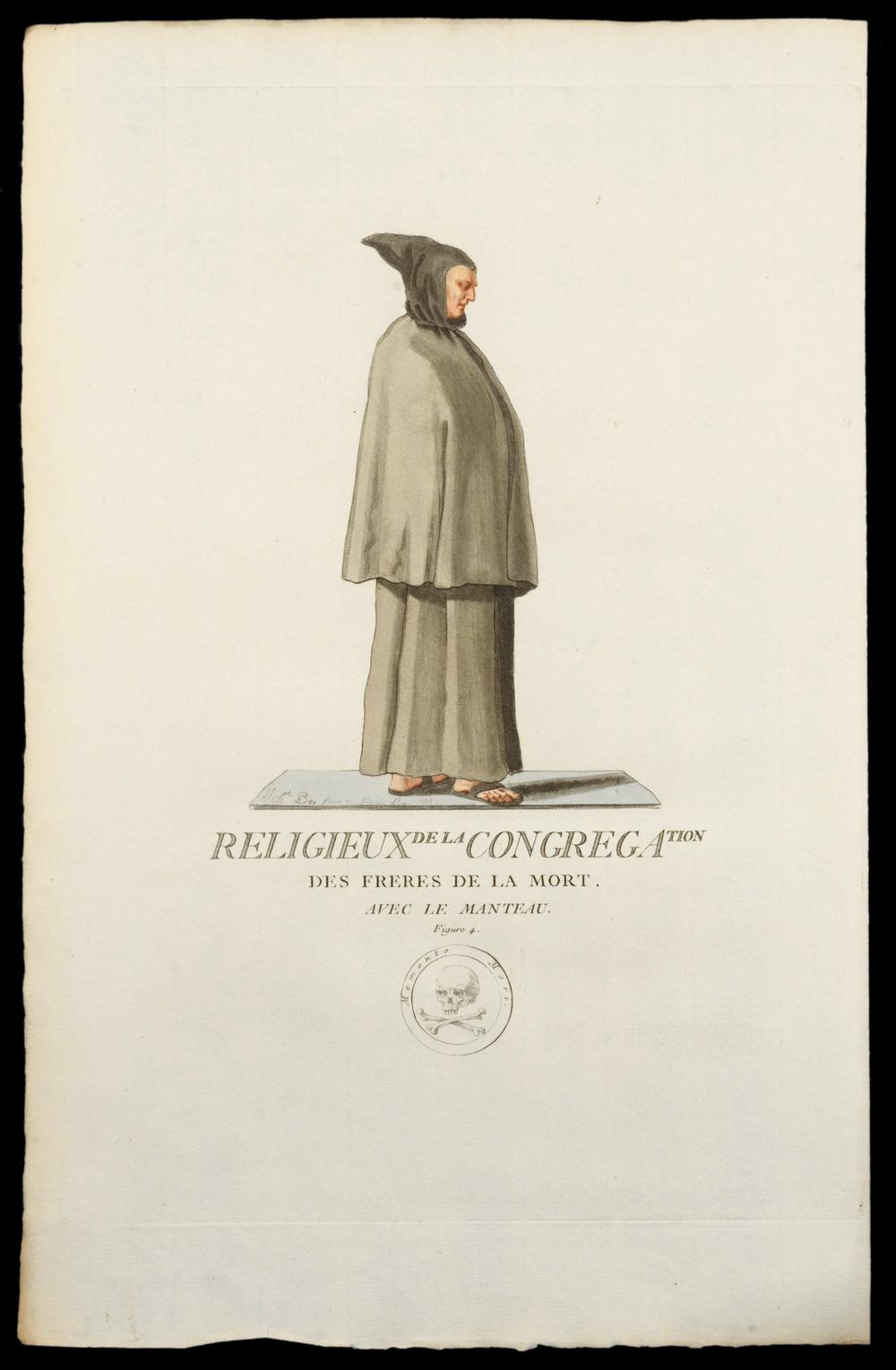
Rare and impressive series depicting the Brothers of Death, an Italian confraternity now extinct, devoted to funerary rites and the burial of the dead.
These men, dressed entirely in black and bearing on their chests a skull with crossed bones, were not masked: their faces remained visible, grave and impassive, reflecting a faith that confronted the corruption of the world without evasion.
Their role was as concrete as it was terrifying: collecting abandoned bodies, burying plague victims, accompanying public executions, and preparing the dead for burial.
In Italian cities, they could be seen at dusk, carrying torches and crosses, walking ahead of carts laden with corpses.
Their motto, Misericordia e Morte, summed up the terrible charity they practiced: to face death in order to remind all that it would come, inevitably.
The three plates engraved by Jacques-Charles Bar depict with almost theatrical precision the brother without cloak, the brother wearing his ceremonial cloak, and the lay brother — three embodiments of this brotherhood of the grave.
Their gazes are calm, almost frozen; the deep black of the garments contrasts with the pallor of the faces and the skeletal symbol of vanity.
Bar, an 18th-century French engraver, excelled at capturing the tension between faith and death.
These period impressions, executed in etching and hand-enhanced with watercolor, still bear the plate mark visible around the entire perimeter, evidence of an early impression printed on a hand press.
Provenance : private European collection.
An ensemble of striking intensity, ideal for a cabinet of curiosities, a collection of macabre art, or a gothic interior.
These three engravings evoke a world in which piety was expressed in direct contact with the charnel house — where the living walked alongside death in a religious and fascinating silence.