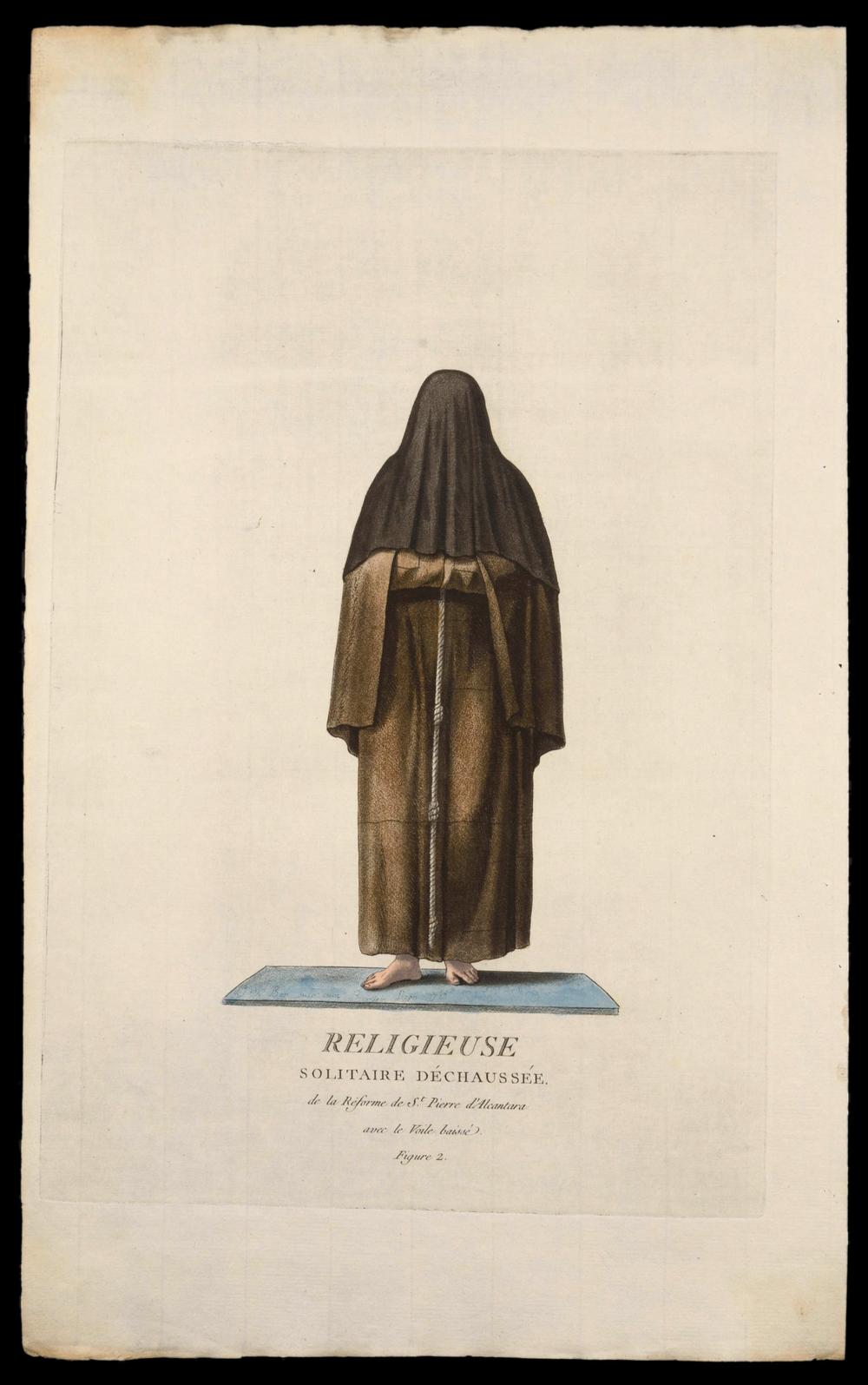
SOLITARY BAREFOOT NUN – ORIGINAL 18TH-CENTURY ENGRAVING
SOLD — This object is now part of a private collection
SOLITARY BAREFOOT NUN – ORIGINAL 18TH-CENTURY ENGRAVING
Our prices are in euros, the prices converted in dollars or other currencies can vary according to the rate.
Free shipping – fast and secure delivery.
ref: #RK00-866Couldn't load pickup availability
Barefoot Nun of the Reform of Saint Peter of Alcántara
Original etching, hand-enhanced with watercolor
France, circa 1780–1790
Dimensions: 41 cm × 26 cm
Size : 16.2" × 10.2"
Condition: excellent – intact margins, period laid paper, visible copperplate marks
Striking and unsettling representation of a barefoot nun belonging to the reform of Saint Peter of Alcántara, one of the most austere and secretive orders of the early modern period.
The sister, seen from behind, veil lowered, seems to withdraw into nothingness.
No face, no gesture, no setting: only a human shadow, motionless, lost in the half-light of contemplation.
This engraving, of silent power, depicts the absolute effacement of being before God.
The barefoot nuns lived enclosed in bare cells, walking barefoot on cold stone, speaking only to God and nourishing themselves solely through prayer.
Their existence was a liturgy of disappearance: they erased themselves from the world in order to be consumed more fully in prayer and penance.
Their coarse, unadorned brown habit symbolized the earth — their living tomb.
In Bar’s work, austerity becomes vision: this faceless figure seen from behind embodies both the mysticism of renunciation and the terror of spiritual annihilation.
It is an almost ghostly image, where holiness and death merge.
Original etching, hand-enhanced with watercolor, printed on a hand press at the end of the 18th century.
The copperplate marks visible all around attest to a period impression.
Provenance: private European collection.
A work of poignant sobriety, at the crossroads of religious art, mysticism, and silence.
Ideal for a cabinet of curiosities, a collection of sacred or macabre art, or a monastic and Gothic interior.
An image in which disappearance becomes beauty, and faith, a form of shadow.