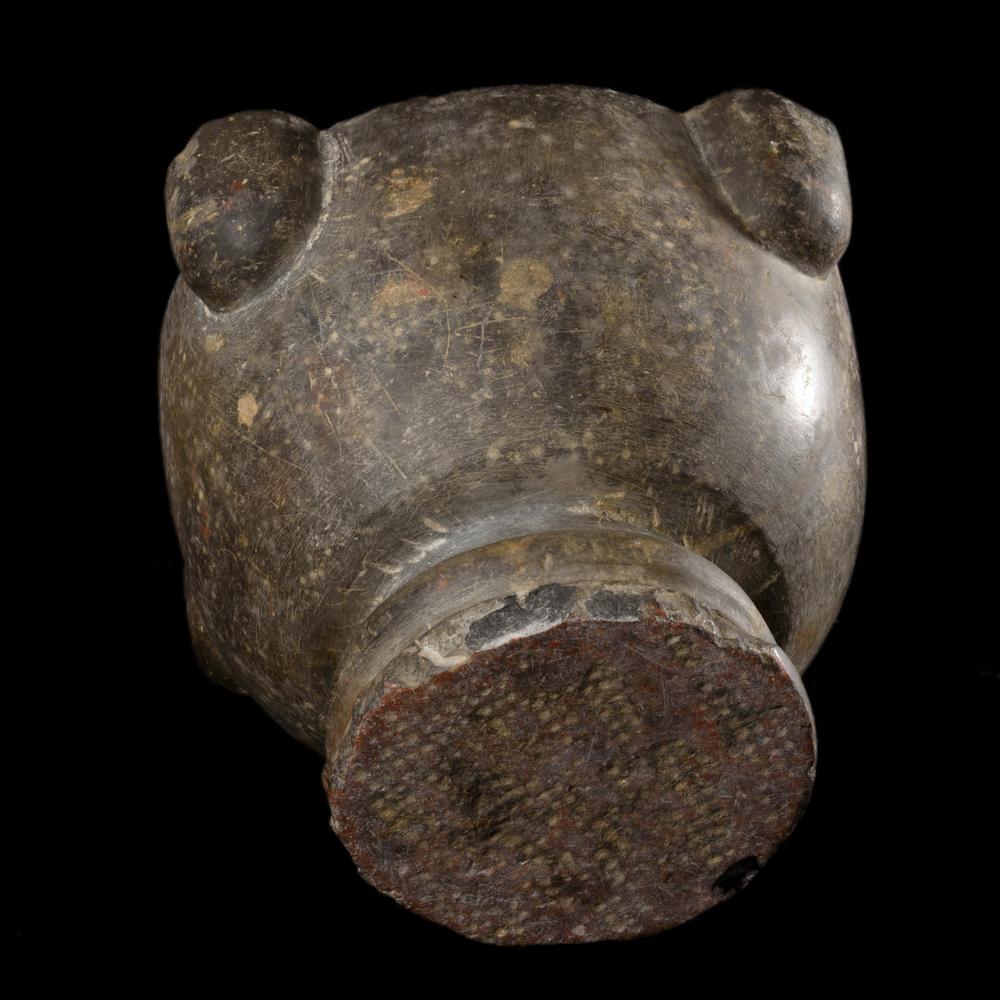
SERPENTINE MORTAR, 17TH CENTURY
SOLD — This object is now part of a private collection
SERPENTINE MORTAR, 17TH CENTURY
Our prices are in euros, the prices converted in dollars or other currencies can vary according to the rate.
Free shipping – fast and secure delivery.
ref: #RK00-894Couldn't load pickup availability
Important antique mortar carved from a dark hard stone, very likely serpentine, datable to the 17th century and attributable to an Alpine European or Northern Italian production. The object displays a powerful and well-balanced form, with a widely flared body resting on a circular foot, a thick rim articulated with lobed hand-grips carved from the mass, and a carefully shaped angular pouring spout designed to facilitate the transfer of crushed, liquid, or powdered preparations.
The interior basin is deeply hollowed and exhibits a strongly developed old polish, the result of intensive and prolonged use, attesting to its original function—most likely intended for pharmaceutical or monastic purposes, and possibly associated with alchemical or occult practices. The exterior surface retains a dark, dense, and homogeneous patina with subtly satin reflections, characteristic of hard stones long handled and exposed to repeated friction. This intact and unaltered patina gives the object an authentic presence and considerable visual strength.
In the 17th century, serpentine enjoyed a particular reputation: it was believed to react upon contact with harmful substances, some even thinking it could alter or tarnish in the presence of poisons. This belief, widespread in learned and medical circles, explains the preferred use of this stone for the preparation of potentially dangerous materials, where vigilance and the practitioner’s protection were paramount. The very choice of material thus formed part of a practice of active precaution, in which the object became both an aid to knowledge and a symbolic safeguard.
The state of preservation is very good for an object of this period: the visible wear is old, coherent, and fully stabilized, particularly at the base and along certain edges, with no structural cracks or restorations. Minor marks, small chips, and irregularities fully contribute to its character and attest to genuine use over several generations, excluding any later purely decorative production.
Through its mass, material, and deeply historical patina, this mortar stands as a fine example of 17th-century hard stone utilitarian art—both functional and sculptural—imbued with a memory where knowledge, caution, and the transformation of matter intersect. A collector’s object of strong presence, it naturally finds its place in a cabinet of curiosities as a discreet witness to ancient practices in which gesture, stone, and danger were intimately linked.
PERIOD : 17th century
DIMENSION : 21 cm × 15 cm
SIZE : 8.3" × 5.9"