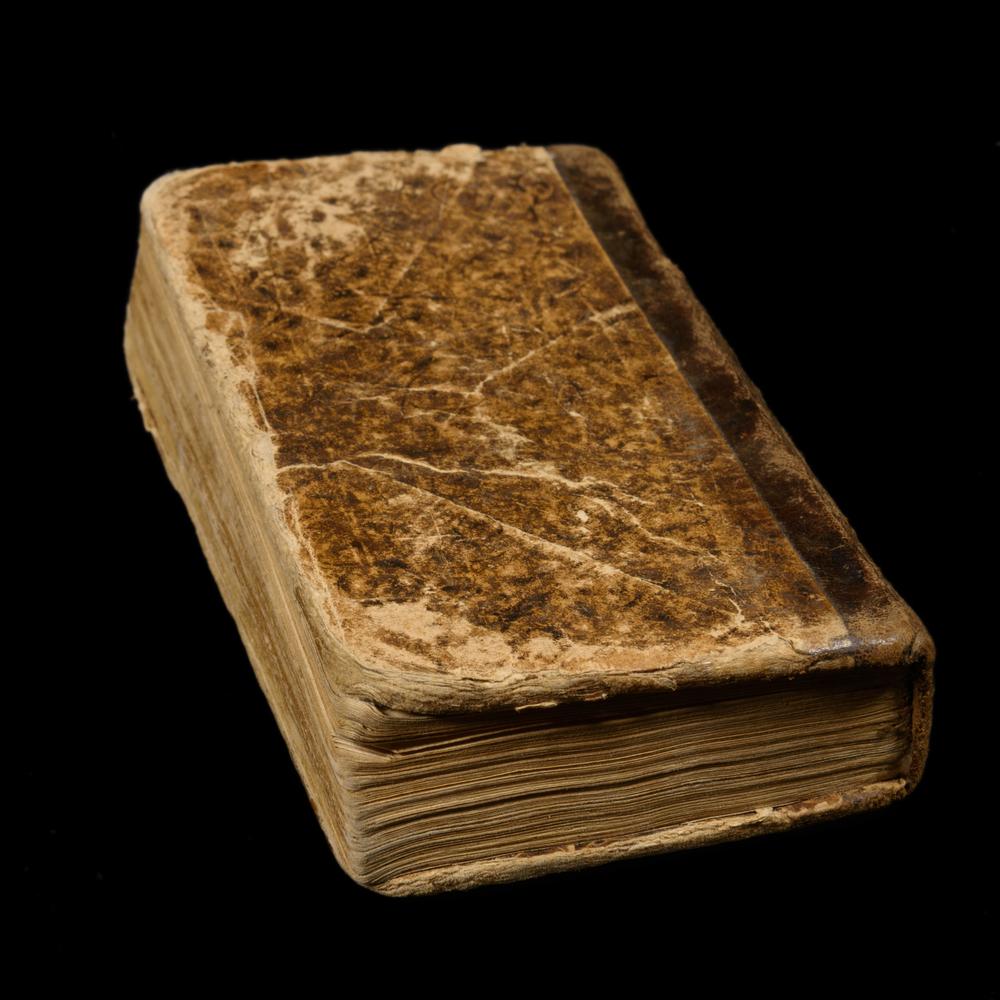
SACERDOTE PROVEDUTO – Rites and Exorcisms, 18th century, under the control of the INQUISITION
SACERDOTE PROVEDUTO – Rites and Exorcisms, 18th century, under the control of the INQUISITION
Our prices are in euros, the prices converted in dollars or other currencies can vary according to the rate.
Free shipping – fast and secure delivery.
ref: #RK00-896Couldn't load pickup availability
Rites, Blessings and Exorcisms
Operative priestly manual under the control of the INQUISITION – Italy, 18th century
This volume is neither a book of personal devotion nor a work intended for study. It is an operative priestly manual, printed to be used by priests in the direct exercise of their ministry, in the face of illness, agony, fear of judgment and the action of the demon. Entitled Sacerdote Proveduto and printed in Brescia in 1757, this work fully belongs to the official religious practice of Catholic Italy in the eighteenth century.
The book was conceived as a practical field tool. Its portable format, its period full-leather binding now deeply patinated, as well as the visible loosening of the pages indicate a volume intended to be carried, quickly opened and consulted in urgent situations. It accompanied the priest into private houses, rural areas, at the bedside of the dying and in troubled places, wherever the presence of evil was considered immediate and dangerous.
The content of the Sacerdote Proveduto is remarkably dense. It brings together rites for assisting the dying and administering the sacraments, but above all an extensive body of blessings, conjurations and exorcisms. These formulas were intended to compel the demon, to repel his action upon persons, animals, houses, lands and places, but also to act against calamities believed to be stirred up by malevolent powers: storms, fires, diseases, persistent disturbances. The demon is never presented as an abstract figure: he is a personal presence, capable of acting upon the world, and whom the priest is charged to confront ritually.
The exorcisms contained in this work are direct, explicit and authoritative. They take the form of commands pronounced in the name of God, injunctions aimed at forcing the demon to withdraw, and invocations intended to restore spiritual order. Nothing is left to improvisation: the words, gestures and sequences are strictly codified. The book does not seek to explain evil, but to combat and subdue it.
This point is essential: the exorcisms contained in this work are neither clandestine nor marginal. They are official, integrated into authorized Catholic practice, and strictly regulated by ecclesiastical authority. It is precisely at this point that the Inquisition intervenes, and this is what radically distinguishes this book from a simple old religious work. The exorcisms it contains are neither marginal nor tolerated out of indulgence. They are officially authorized, and this authorization derives directly from the Venetian inquisitorial system.
At the beginning of the volume appears an official printing license issued by the "Riformatori dello Studio di Padova". In the Republic of Venice, this institution did not merely exercise administrative control. It constituted one of the legal arms of the Inquisition, responsible for the doctrinal examination of religious books. Unlike other regions of Europe where the Inquisition sometimes affixed an explicit signature, Venice used this specific system: no book dealing with sensitive matters — and exorcism fully belonged to them — could be printed without the approval of the Holy Office (Sant’Uffizio), conveyed through the Riformatori.
The printed formula specifies that the text was examined, that it contains nothing contrary to the Catholic faith, and that authorization is granted for its printing and circulation. This means concretely that the exorcisms, prayers against the demon and protective formulas were read, evaluated and validated within an official inquisitorial framework. This book is therefore not only religious: it is a direct product of inquisitorial control over the struggle against evil.
The linguistic structure of the book confirms its operative purpose. The instructions are written in Italian, so that the priest may understand precisely when and how to act. The essential formulas — solemn blessings, conjurations and exorcisms — are in Latin, the ritual and juridical language of the Church, since they are the very words that must be pronounced for the act to be considered valid. This alternation is not stylistic: it corresponds to a real, repeated and fully assumed practice.
The present copy bears the clear marks of concrete and prolonged use. The binding is heavily patinated, the pages softened, and traces of handling are visible. This is not a preserved volume, but a book that was held, opened and consulted in situations where the priest had to act without delay. This wear is not accidental: it is the direct consequence of the book’s function.
The Sacerdote Proveduto is today a rare material testimony to the control exercised by the Inquisition over the struggle against the demon. It is not a book about the Inquisition: it is a book born under its authority, authorized by it, and used in a struggle considered real. It preserves the trace of a world in which evil was present, named and confronted, and in which the words written on these pages were believed capable of compelling a hostile power.
Condition and bibliophilic description
In-12 volume (duodecimo), 288 pages. Period full-leather binding, spine with raised bands and gilt title, showing deep patina and wear consistent with prolonged ritual use. Rubbing, old handling marks, no modern restoration. Clean interior, sharp and legible printing. A solid work, well preserved for an operative priestly manual of the eighteenth century.
Format : in-12 (duodecimo), 288 pages
Dimensions : approx. 14 × 7.5 cm
Size : approx. 5.5" × 3"
Language : Italian and Latin
Date : 1757
Binding : period full leather, raised bands, gilt title