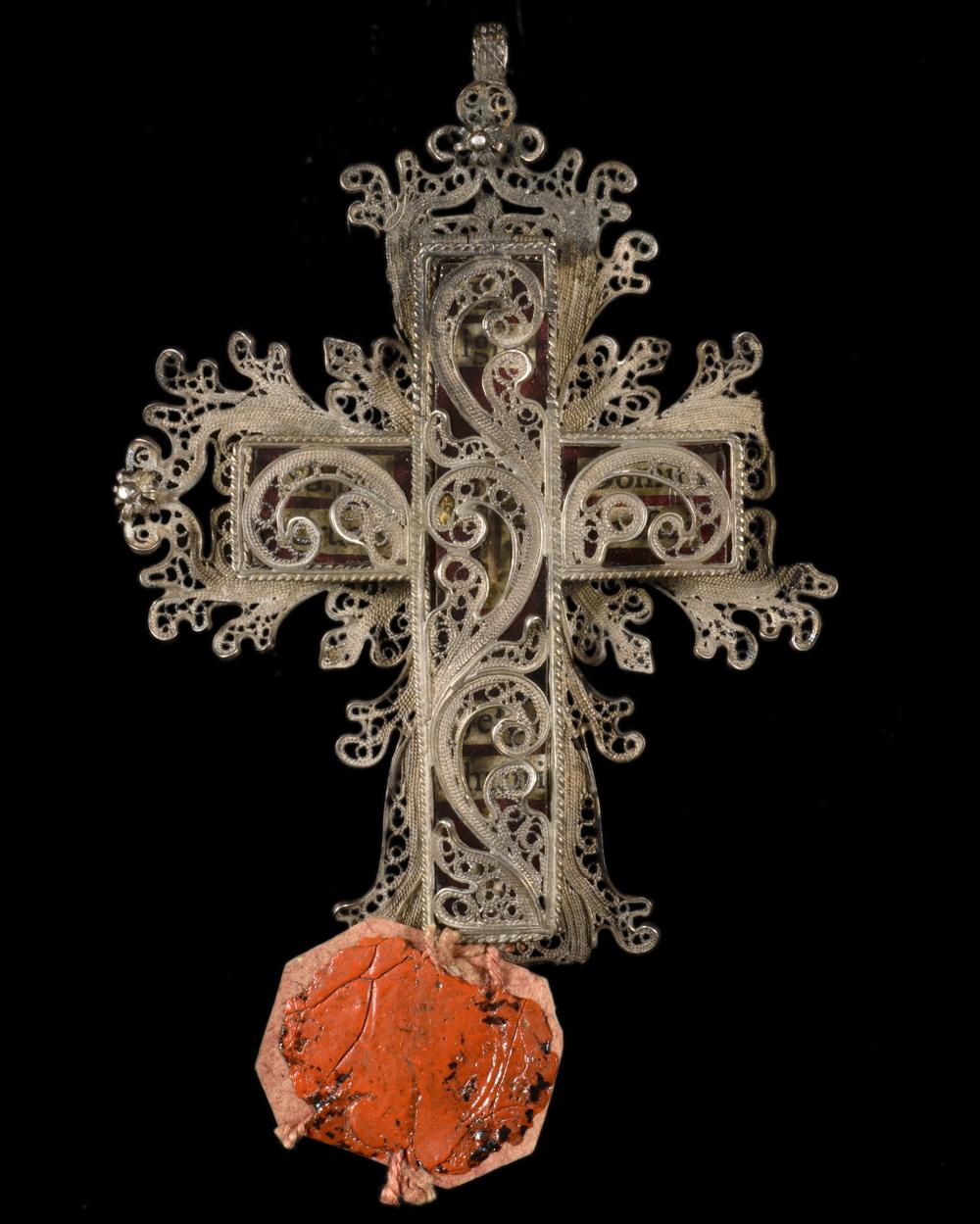
RELIQUARY OF THE TRUE CROSS + DOCUMENT
SOLD — This object is now part of a private collection
RELIQUARY OF THE TRUE CROSS + DOCUMENT
Our prices are in euros, the prices converted in dollars or other currencies can vary according to the rate.
Free shipping – fast and secure delivery.
ref: #RK00-789Couldn't load pickup availability
This cross-shaped reliquary is a precious devotional object, designed to house and protect a relic of the True Cross, that is, a fragment from the wood of Christ’s Cross. The entire piece is crafted in silver filigree, a refined goldsmith’s technique consisting of twisting and soldering fine metal wires to form delicate and openwork patterns. The result is a structure that is both light and elegant, where scrolls, arabesques, and decorative spirals intertwine. This type of ornamentation is characteristic of the Baroque art of the 17th and 18th centuries, a period during which the Catholic Church sought to exalt the beauty and splendor of sacred objects in order to inspire admiration and devotion.
At the heart of the cross, behind small glass windows, rests a fragment of wood, placed vertically, identified as a relic of the Cross of Christ. The presence of this fragment makes it an object of inestimable spiritual value for the faithful, who saw in these relics a tangible connection with the Passion and the redemptive sacrifice of Jesus. Around the fragment, inserted into tiny cartouches, are small handwritten slips of paper, called tituli. These labels, written in Latin, specify the origin and nature of the relic, thus serving for its identification and official recognition by ecclesiastical authorities.
EX Ligno Sanctae Crucis Domini nostri Jesus Christi
→ From the wood of the True Cross of Our Lord Jesus Christ.
The reliquary is accompanied by an original authentic document issued by Brother Antonio Ligi-Bussi Urbinas in 1861, certifying the authenticity of the relics contained inside.
"Brother Antonio Ligi-Bussi Urbinas, of the Order of Conventual Friars Minor, by the grace of the Apostolic See Archbishop of Iconium, Commendatory Abbot of Saint Lawrence Outside the Walls, Domestic Prelate of His Holiness, Assistant at the Pontifical Throne, and Vicar General of His Holiness for the city of Rome.
To all and each who shall read these present letters, we make known and attest, for the greater glory of Almighty God and for the edification of the faithful, that we have recognized and authenticated holy particles of the wood of the True Cross of Our Lord Jesus Christ.
These relics, taken from authentic places, we have piously placed in a silver cross-shaped reliquary, fitted with crystal, well sealed, bound with a red silk cord, and marked with our seal. We have entrusted them to be preserved, given, or transmitted outside the City, and to be exposed to the public veneration of the faithful in any Church, Oratory, or Public Chapel.
In witness whereof, we have ordered that these present letters be drawn up and provided with our subscription and the seal of our arms.
Given at Rome, in our residence, on the 22nd day of September, 1861."
Unopened.
Ecclesiastical seal and silk threads present.
Reliquaries containing a relic of the Lignum Crucis rank among the rarest devotional objects accessible today. From the earliest centuries of Christianity, fragments of the True Cross were subject to exceptionally strict supervision and preservation, being primarily kept in major sanctuaries and ecclesiastical treasuries.
The authentics issued in the 19th century to accompany these relics were granted with great restraint, often to religious communities or to high-ranking members of the faithful. Their survival in intact condition, with a sealed reliquary and original document, is today exceptionally rare on the market.
EPOCH : 1861
DIMENSION : 8.5 cm X 6 cm
SIZE : 3.4" X 2.2"
Antonio Ligi-Bussi (1799–1862) was a Franciscan Conventual friar from Urbino, Italy. Entering the Order of Conventual Friars Minor at a very young age, he made Franciscan spirituality the central axis of his life. His exemplary path within the Franciscan family led him to be called to Rome, where he assumed increasing responsibilities in the service of the Holy See. In 1840, he was appointed Titular Archbishop of Iconium, while remaining deeply attached to his identity as a Minor Friar. He later became Commendatory Abbot of Saint Lawrence Outside the Walls and, above all, Vice-Gerent of the Diocese of Rome, a role he held from 1851 until his death. In keeping with the Franciscan tradition of service and humility, he dedicated himself to the dissemination of relics, their authentication, and the promotion of popular devotion. His seals and signatures appear on numerous 19th-century reliquaries, bearing witness to his mission of ensuring the continuity of Catholic piety. He died in Rome in 1862, leaving the image of a prelate faithful to the spirit of Saint Francis, combining episcopal dignity with Franciscan simplicity.