RELIQUARY OF THE HOLY SHROUD AND SAINT JUSTIN
SOLD — This object is now part of a private collection
RELIQUARY OF THE HOLY SHROUD AND SAINT JUSTIN
Our prices are in euros, the prices converted in dollars or other currencies can vary according to the rate.
Free shipping – fast and secure delivery.
ref: #RK00-892Couldn't load pickup availability
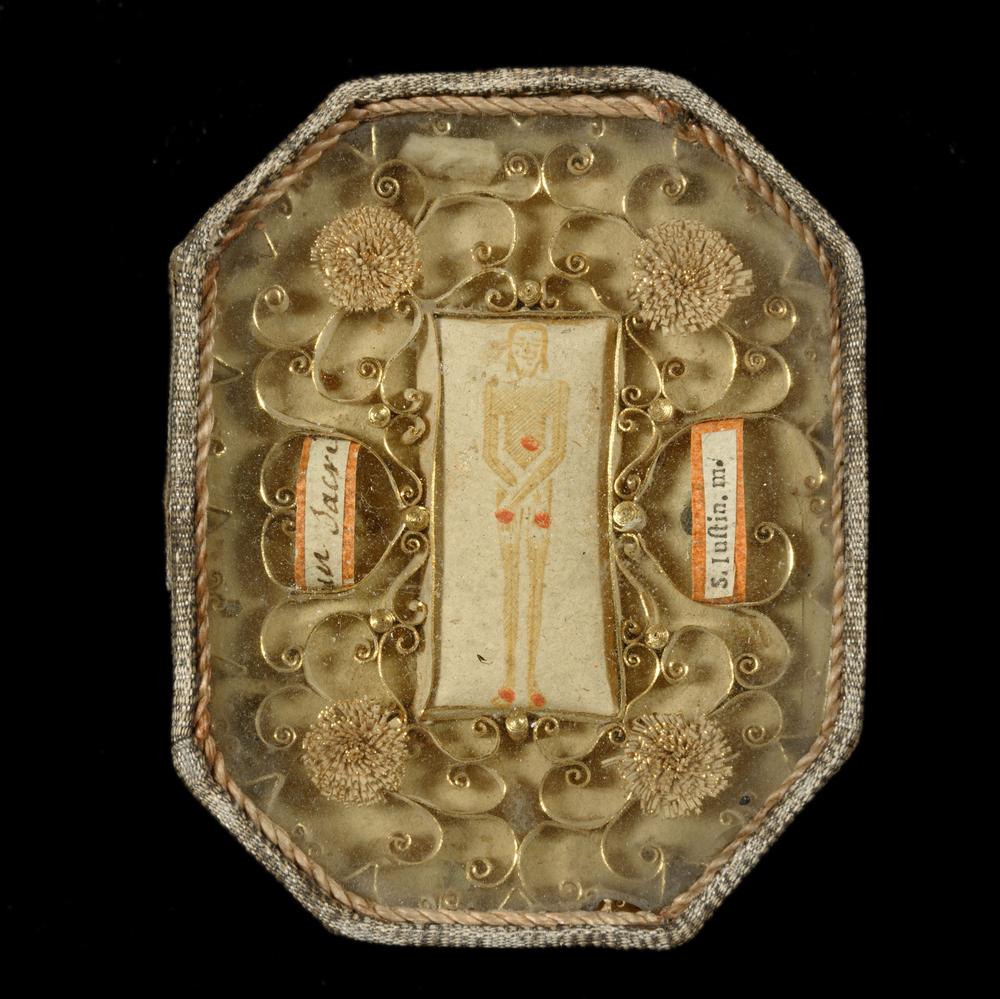
Rare 18th-century reliquary, octagonal in form, with a glazed front, containing a relic associated with the Holy Shroud as well as a relic of Saint Justin, philosopher and martyr.
The relics are arranged on a light-colored fabric ground and richly framed with delicate gilded-edge paperoles forming an intricate network of volutes and radiating motifs, symbolically evoking heavenly glory and sanctity.
The relic associated with the Holy Shroud is identified by an old handwritten Latin label bearing the inscription: « In Sacri ».
This inscription designates a fragment originating from a sacred element (in sacri), a formula used in ecclesiastical vocabulary to qualify relics linked to major devotional objects or to textiles of the Passion. In the case of the Holy Shroud — preserved as a relic of the highest order and surrounded by exceptional veneration —
The relic of Saint Justin, for its part, is clearly identified by a second handwritten Latin label:
« S. Iustin. m. » (abbreviation of Sanctus Iustinus martyr).
At the center, a stylized representation of the body of Christ bearing the marks of the Passion — wounds of the hands, feet, and side — reinforces the devotional reading of the ensemble and establishes a visual and theological link between the Holy Shroud and the witness of Christian martyrdom.
The piece is preserved in good condition for use, retaining its original glass, original materials, and intact interior presentation, consistent with 18th-century devotional mounting practices. The composition has remained sealed and has not been dismantled, guaranteeing the authenticity of the relic arrangement.
Relics associated with the Holy Shroud are particularly rare and have always been treated with great reserve by the Church, their distribution having been strictly regulated. They were intended for private or conventual veneration rather than public display.
Relics of Saint Justin are likewise uncommon. Martyred in Rome in the 2nd century, his relics were early fragmented and dispersed, mainly preserved in the catacombs and in a few Roman basilicas. Authenticated fragments that have come down to us are rare and are most often incorporated into early devotional reliquaries of learned character.
The absence of a visible episcopal seal is explained by the original destination of this reliquary, designed for private or conventual devotional use during the 18th century. At that time, small paperole reliquaries, assembled according to specific artisanal practices and sealed at the time of their construction, were not systematically fitted with an external seal, particularly when not intended for public circulation or official translation. Authenticity was then primarily guaranteed by the presence of handwritten Latin labels, by the iconographic and theological coherence of the composition, and by the integrity of the interior presentation, which has remained intact. This type of mounting, closed and undismantled since its origin, corresponds to an established devotional tradition and in no way constitutes an anomaly for a reliquary of this nature and period.
PERIOD: 18th century
DIMENSIONS: approx. 8 × 6.5 cm
SIZE: approx. 3.1" × 2.6"
Saint Justin, born around the year 100 in Flavia Neapolis (modern-day Nablus), was one of the greatest thinkers of early Christianity. A philosopher trained in the Greek schools — Stoic, Peripatetic, and Platonic — he sought truth throughout his life through reason before recognizing in Christianity the ultimate fulfillment of the philosophical quest.
After converting to the Christian faith, he retained the philosopher’s cloak and presented himself as a Christian philosopher, convinced that faith did not abolish reason but brought it to fulfillment. In his Apologies and in the Dialogue with Trypho, he defended Christians before the Roman authorities and engaged in a demanding dialogue with pagan philosophy and Judaism.
Under the reign of Marcus Aurelius, denounced for his faith, Justin refused to sacrifice to the pagan gods. He was condemned and beheaded in Rome around 165. His martyrdom sealed a life entirely dedicated to truth, lived to the point of supreme witness.
Venerated as a saint and martyr in both East and West, Saint Justin remains a major figure in Christian history, a symbol of the union of faith, reason, and spiritual courage. His feast is celebrated on June 1.