RELIQUARY OF THE HOLY FAMILY — CRADLE OF CHRIST, VEIL OF THE VIRGIN, SAINT JOSEPH
RELIQUARY OF THE HOLY FAMILY — CRADLE OF CHRIST, VEIL OF THE VIRGIN, SAINT JOSEPH
Our prices are in euros, the prices converted in dollars or other currencies can vary according to the rate.
Free shipping – fast and secure delivery.
ref: #RK00-901Couldn't load pickup availability
Rare gilded bronze reliquary with a glass front containing three precious Christological and Marian relics.
The relics are fixed at the center of a refined decorative composition. They rest on a deep red textile background. This color, omnipresent in Christian liturgy, symbolizes the blood of Christ and His redemptive sacrifice.
They are identified in Latin on handwritten labels as follows:
“Ex Cunis D.N.J.C”
→ Ex cunis Domini Nostri Jesu Christi
Translation : From the cradle of Our Lord Jesus Christ
This relic, of great symbolic rarity, refers to the mystery of the Nativity. The term cunis (cradle, swaddling clothes, or bed of the Child) evokes the first earthly hours of Christ, His humble and physical incarnation. It recalls the poverty of Bethlehem and the tangible reality of God made man. Associated with relics of the Passion, it situates the reliquary within a complete theology, from birth to sacrifice.
“Ex velo B.M.V.”
→ Ex velo Beatae Mariae Virginis
Translation : From the veil of the Blessed Virgin Mary
A highly venerated Marian relic, the veil of the Virgin refers to her purity, her sacred motherhood, and her role of intercession. It also symbolizes the maternal protection granted to the faithful. In iconography and devotion, the veil becomes a sign of gentleness, refuge, and mediation between heaven and mankind.
“Ex pallio S. Ios. sp”
→ Ex pallio Sancti Ioseph Sponsi
Translation : From the cloak of Saint Joseph, Spouse
Good condition of use with its original glass.
Unopened.
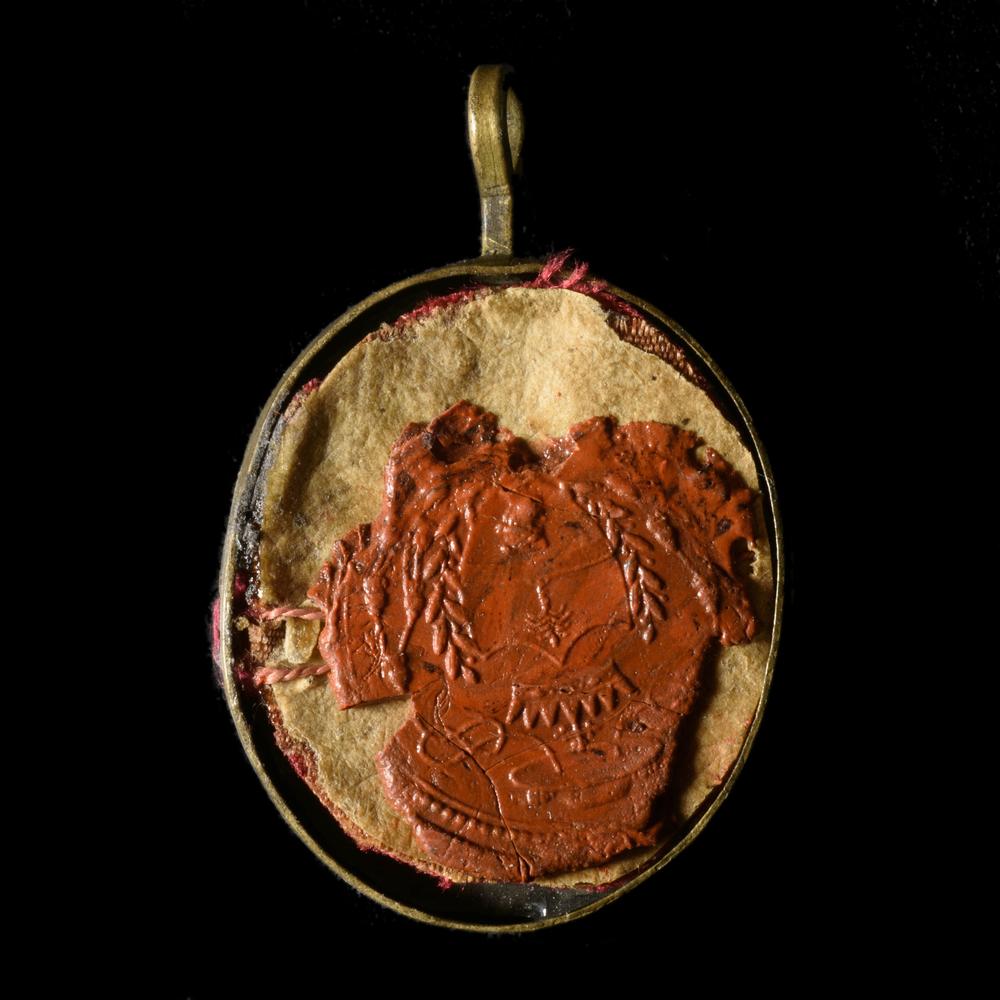
Ecclesiastical seal and silk threads present.
PERIOD : 18th century
DIMENSION : 4.5 cm × 3 cm
SIZE : 1.8" × 1.2"
This reliquary thus brings together three complementary dimensions of the Christian mystery:
— The Incarnation (the Cradle of Christ),
— Sacred motherhood and intercession (the Veil of Mary),
— Paternal protection (the Cloak of Joseph).
It forms a true relic of the Holy Family, encompassing the earthly birth of the Savior, His domestic environment, and the protective love that surrounded His earliest years.
The mere presence of a relic materially associated with the childhood of Christ already constitutes, in itself, a fact of extreme rarity. The so-called Christological contact relics — that is to say relics linked to objects that directly touched the earthly life of Jesus — are among the most difficult to encounter on the antique market, most having been preserved for centuries within major ecclesiastical treasuries, cathedrals, or monastic foundations. Fragments referring to the cradle or the swaddling clothes of the Child Jesus belong to this exceptional category, touching the most intimate mystery of the Incarnation: God made flesh in the fragility of a newborn.
To this first rarity is added that of a relic of the Veil of the Blessed Virgin Mary. Marian textile relics, by their perishable nature, are infinitely less common than the bone relics of saints. They were jealously preserved, sparingly fragmented, and often reserved for major religious foundations or high-ranking ecclesiastical protectors. In Christian symbolism the veil surpasses the material object itself, becoming a sign of purity, divine motherhood, and protective mediation.
Finally, the relic of the Cloak of Saint Joseph completes this ensemble with a strong theological significance. Saint Joseph, long discreet in Western devotion before its later expansion, nonetheless remains the protective figure par excellence of the Holy Family. Textile relics attributed to him are likewise uncommon and refer to his role as guardian, provider, and silent witness of the mystery of the Incarnation.
Yet beyond the individual rarity of each relic, it is their union within a single reliquary that gives this piece its full spiritual and historical value. They are no longer isolated fragments but part of a coherent devotional program conceived as a material evocation of the sacred family household of Nazareth.
The faithful do not merely venerate a memory of Christ’s life, nor a Marian or Josephite attribute taken separately: they contemplate a sacred domestic ensemble — the cradle, the veil, the cloak — in other words the very objects that surrounded, protected, and sheltered the first earthly days of the Savior.
This union thus forms a family trinitarian relic, where the Child, the Mother, and the foster father are mystically present through their contact textiles. It evokes the warmth of the home of Nazareth, the blessed poverty of the Nativity, and the loving protection that surrounded the Incarnation.
Such compositions are significantly rarer than reliquaries containing multiple saints or martyrs, as they imply a precise theological intention: to represent not the triumphant Church, but the Holy Family in its earthly intimacy.
This reliquary therefore belongs not only to the devotion to relics, but to a deeply incarnational spirituality centered on the familial mystery of God made man — a material meditation on birth, love, and protection at the very heart of Christian salvation.