RELIQUARY OF THE EXTENDED HOLY FAMILY
SOLD — This object is now part of a private collection
RELIQUARY OF THE EXTENDED HOLY FAMILY
Our prices are in euros, the prices converted in dollars or other currencies can vary according to the rate.
Free shipping – fast and secure delivery.
ref: #RK00-939Couldn't load pickup availability
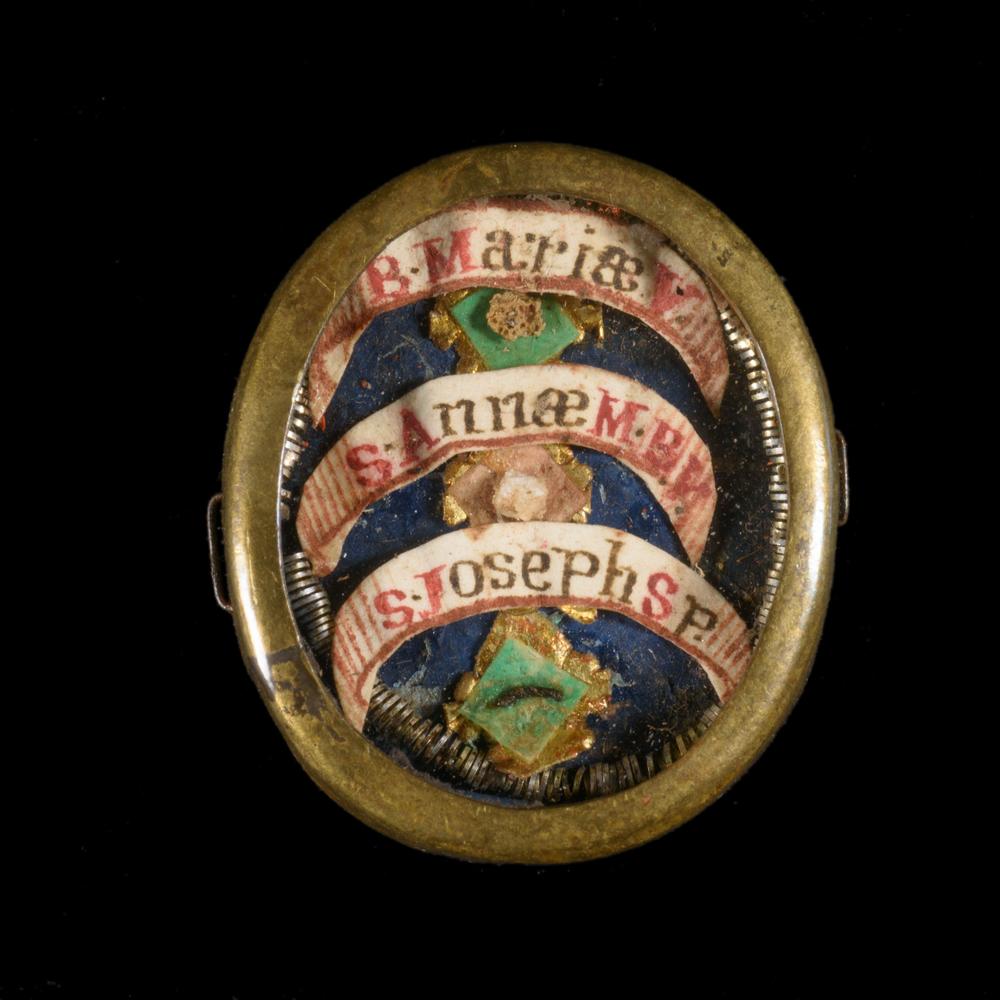
Rare oval 18th-century reliquary in brass with a glass front, containing three relics identified by handwritten inscriptions on paper phylacteries.
This reliquary features a simple brass mount with a smooth border, typical of 18th-century devotional productions. The original glass front protects a finely arranged interior composition, set in a fixed mounting intended for the long-term preservation of the relics.
The deep blue background, evoking the celestial sphere, serves as a setting for the whole. Three handwritten phylacteries, arranged in superimposed registers, identify the relics in a script alternating between black and red ink:
“B. Mariae Virg.”
→ Beatae Mariae Virginis
Translation: Of the Blessed Virgin Mary
“S. Annae MBM.”
→ Sancta Anna Mater
Translation: Saint Anne, mother of the Virgin Mary
“S. Joseph Sp.”
→ Sanctus Joseph Sponsus
Translation: Saint Joseph, spouse of the Virgin Mary
Each relic is set within a small ornamental arrangement, enhanced with gilded fragments and framed by twisted metal threads, in a discreet yet refined aesthetic characteristic of convent workshops.
Good condition with original glass.
Unopened.
Ecclesiastical seal and silk threads present.
PERIOD : 18th century
DIMENSION : approx. 2.7 cm × 2.2 cm
SIZE : 1" × 0.9"
This reliquary forms an ensemble of remarkable spiritual coherence, centered on the sacred genealogy of Christ through Mary, his mother, Saint Anne, and Saint Joseph. The combined presence of these three figures establishes a continuity of holiness, a transmission of the divine inscribed within human lineage.
The relic of the Blessed Virgin Mary, placed in a dominant position, embodies the heart of the mystery of the Incarnation. Saint Anne represents the origin of this election, while Saint Joseph appears as the silent guardian of the incarnate mystery.
In a more interior reading, this triad may be perceived as a structure of balance: purity, origin, and protection. It forms a harmonious whole in which the sacred unfolds through lineage, transmission, and the safeguarding of the mystery.
As an object of intimate devotion, this reliquary acts as a condensation of incarnate theology, in which the Holy Family becomes the very place of the manifestation of the divine.