RELIQUARY OF SAINT ELIZABETH OF HUNGARY
RELIQUARY OF SAINT ELIZABETH OF HUNGARY
Our prices are in euros, the prices converted in dollars or other currencies can vary according to the rate.
Free shipping – fast and secure delivery.
ref: #RK00-914Couldn't load pickup availability
Rare 18th-century silver reliquary with a glass front containing a relic of Saint Elizabeth of Hungary.
This circular reliquary features a mount in antique silver, now deeply patinated, the perimeter of which is encircled by a collar of pleated wirework forming a radiating border typical of 18th-century baroque conventual settings.
The glazed front protects an interior composition with a symmetrical decoration of gilded scrollwork. The background consists of a deep red textile, a liturgical color associated with sacrificial charity and spiritual royalty. Two blue-tinted lateral compartments frame the central oval, creating a rich chromatic contrast characteristic of 18th-century mountings.
At the center, the relic appears in the form of a light-colored bone fragment, set within an oval medallion bordered by radiating silvered metal threads.
It is identified by a handwritten label:
“S. Elisab. Hung. R.”
→ Sanctae Elisabethae Hungariae Reginae
Translation: Of Saint Elizabeth of Hungary, Queen
This is a relic of Saint Elizabeth of Hungary (1207–1231), a princess who became a Franciscan tertiary and a major figure of medieval Christian charity.
Good condition consistent with use, with original glass.
Unopened.
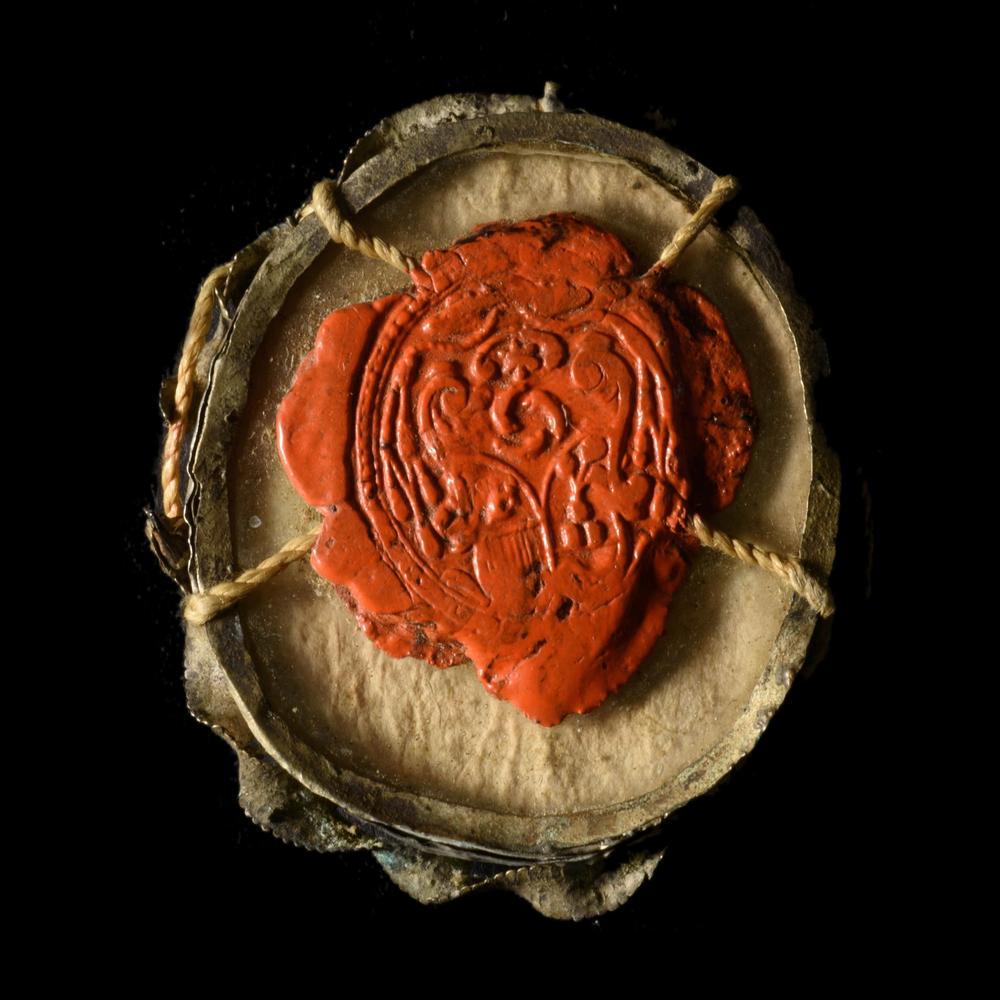
Ecclesiastical seal and silk threads present.
PERIOD : 18th century
DIMENSIONS : 3 cm × 2.5 cm
SIZE : 1.2" × 1"
The presence of a relic of Saint Elizabeth of Hungary places this reliquary within the devotional tradition of the great medieval royal saints. Daughter of King Andrew II of Hungary and wife of the Landgrave of Thuringia, Elizabeth renounced the splendor of the court to embrace a life of poverty and service, dedicating her wealth and energy to the sick, the lepers, and the poor.
Her figure embodies a rare spiritual synthesis: that of royalty transfigured by evangelical humility. A queen by birth and a servant by vocation, she became in the 13th century one of the most powerful models of active Christian charity. Her close association with Franciscan spirituality, whose rule she adopted as a tertiary, contributed to the spread of her cult throughout Europe.
Historically, the diffusion of her relics accompanied the development of hospital institutions and charitable confraternities placed under her patronage. The fragments preserved in 18th-century reliquaries bear witness to this enduring devotion, particularly vibrant in conventual and aristocratic circles.