RELIQUARY OF BLESSED LEONARD OF PORT MAURICE
RELIQUARY OF BLESSED LEONARD OF PORT MAURICE
Our prices are in euros, the prices converted in dollars or other currencies can vary according to the rate.
Free shipping – fast and secure delivery.
ref: #RK00-952Couldn't load pickup availability
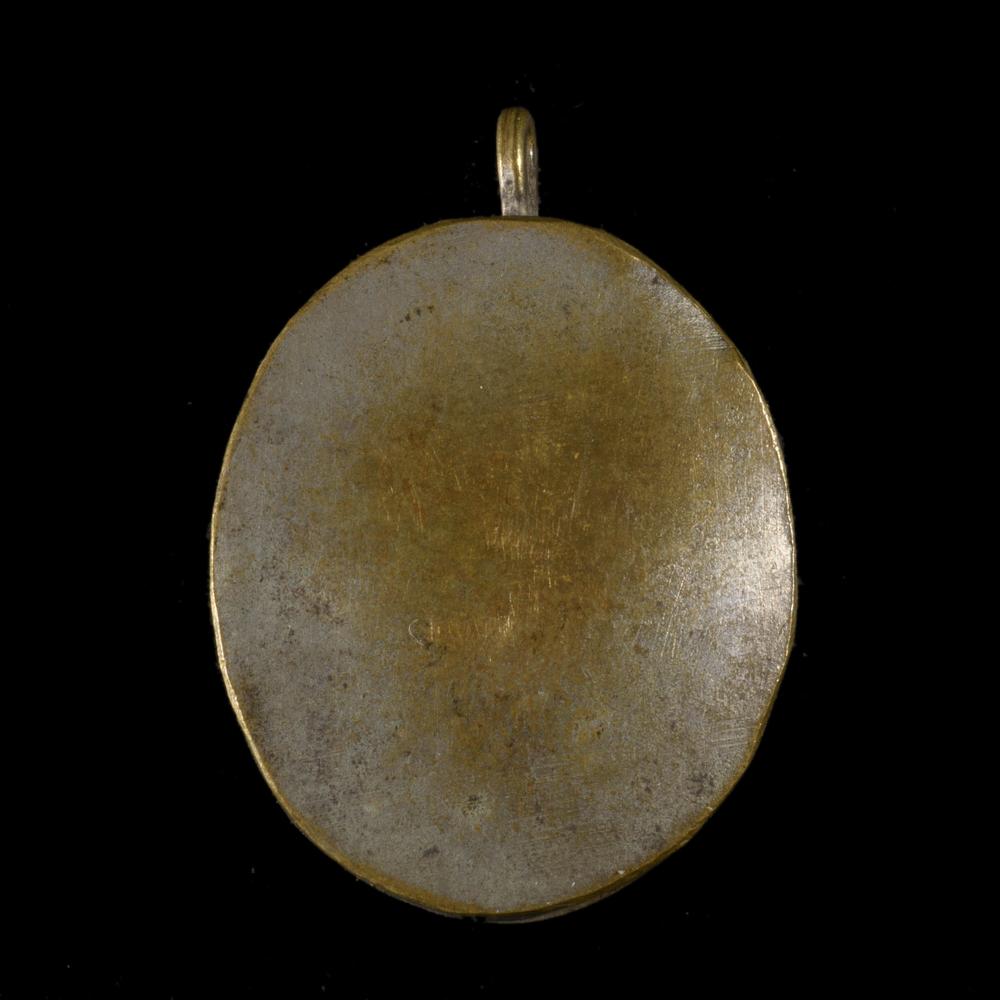
Rare 18th-century oval reliquary in brass with a glass front, containing a textile relic identified by a handwritten inscription as belonging to Leonard of Port Maurice.
This reliquary features an oval brass frame with double molding, surmounted by its original suspension loop. The glass front protects an antique devotional composition, typical of 18th-century reliquaries.
The background is decorated with a radiant design composed of golden motifs on deep red fabric, symbolizing heavenly glory and sanctity. At the center rests a brown textile fragment, carefully preserved in its original setting.
The handwritten inscription visible at the bottom of the composition reads:
“B. Leonardi a Port.”
→ Beati Leonardi a Porto Mauritio
Translation: Blessed Leonard of Port Maurice
This inscription refers to Leonardo da Porto Maurizio, the famous 18th-century Italian Franciscan missionary, renowned popular preacher, and fervent promoter of the Stations of the Cross.
Good condition for use, with original glass.
Unopened.
Ecclesiastical seal and silk threads present.
PERIOD: 18th century
DIMENSIONS: 3 cm × 2.5 cm
SIZE: 1.2\" × 1\"
Leonardo da Porto Maurizio, mentioned here under the form “B. Leonardi a Port.” — abbreviation of Beati Leonardi a Porto Mauritio — refers to Blessed Leonard of Port Maurice before his official canonization. Born in Liguria in 1676, this Reformed Franciscan became one of the most celebrated Italian missionary preachers of the 18th century. He traveled throughout Italy for many years in order to revive the Catholic faith through popular preaching centered on the Passion of Christ and penance. He played a crucial role in spreading the devotion of the Stations of the Cross, which he established in a great number of churches and sanctuaries. His most famous work remains the installation of the Stations of the Cross at the Colosseum in Rome, approved by Pope Benedict XIV. Beatified shortly after his death because of his reputation for holiness, he was ultimately canonized in 1867 by Pope Pius IX. Relics bearing the designation “B.” are particularly interesting because they testify to a production prior to his official canonization.