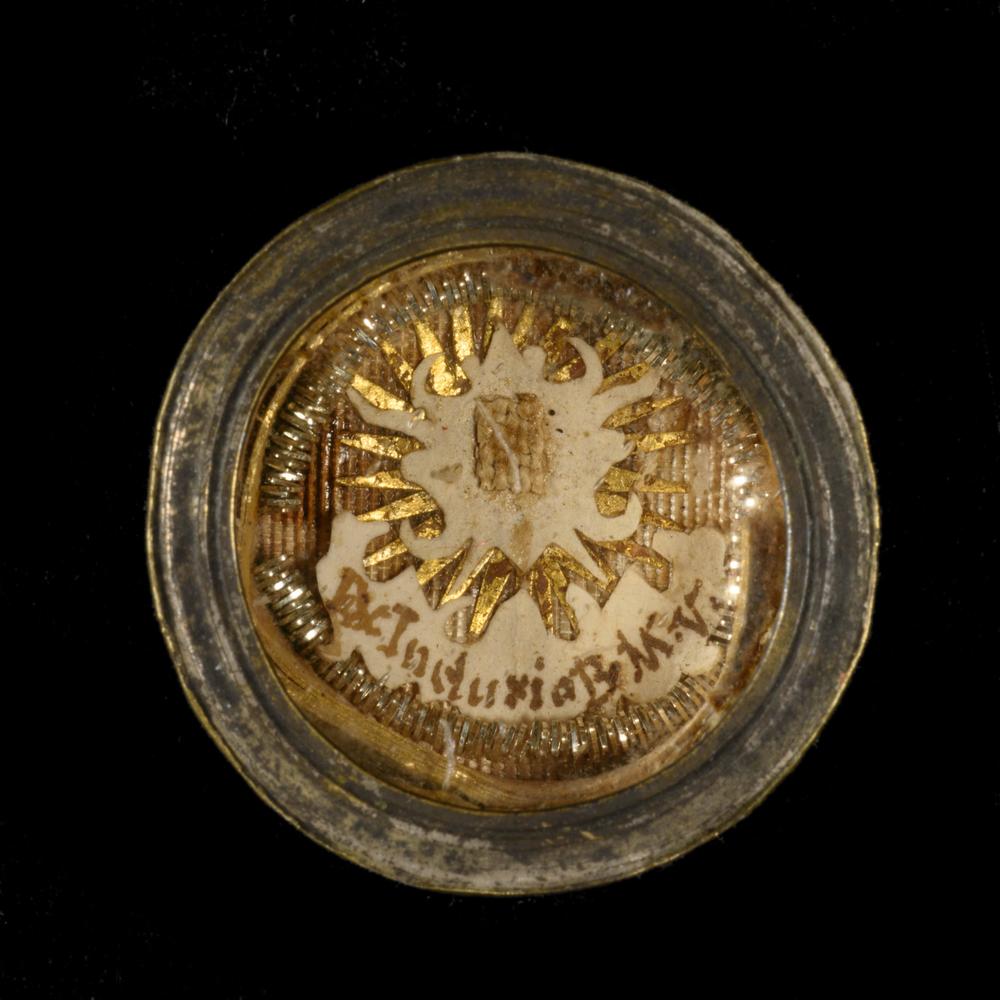
RARE 18TH-CENTURY RELIQUARY — RELIC OF THE GARMENT OF THE VIRGIN MARY
SOLD — This object is now part of a private collection
RARE 18TH-CENTURY RELIQUARY — RELIC OF THE GARMENT OF THE VIRGIN MARY
Our prices are in euros, the prices converted in dollars or other currencies can vary according to the rate.
Free shipping – fast and secure delivery.
ref: #RK00-902Couldn't load pickup availability
Rare gilt bronze reliquary with a glass front containing a precious Marian relic.
This circular reliquary presents a sober and highly structured composition, characteristic of certain 18th-century convent craftsmanship. The relic is placed at the center of a radiant arrangement formed of gilded blades set in a sunburst pattern, emerging from a core cut into a lobed cartouche of light parchment.
The background is composed of a brown-gold moiré fabric, whose subtle reflections enhance the solemnity of the presentation. The relic itself appears as a small ancient textile fragment, fixed at the center of the cartouche and visible through the original, slightly patinated glass.
It is identified in Latin on a handwritten label as follows:
“Ex Induxio B.M.V.”
→ Ex Indusio Beatae Mariae Virginis
Translation: From the garment (tunic / robe) of the Blessed Virgin Mary
This relic belongs to the very restricted category of Marian textile relics. The term indusium (or indusio in devotional spelling) designates a worn garment — tunic, robe, or undergarment — referring to daily and intimate use.
Unlike relics associated with the great scenes of the Gospel, this type of fragment reflects a more interior devotion: it evokes the Virgin’s domestic life, her tangible humanity, and the material reality of her earthly existence.
Marian garment relics are historically rare for several reasons:
-
The perishable nature of textiles
-
Their preservation in major sanctuaries
-
Their very limited distribution
-
Their strong symbolic value in Catholic devotion
They rank among the most sought-after Marian relics, alongside fragments of the Veil.
Good age-related condition with its original glass.
Unopened.
Ecclesiastical seal and silk threads present.
PERIOD : 18th century
DIMENSIONS : 3 cm × 3 cm
SIZE : 1.2" × 1,2"
The relic of the Virgin’s garment points to a deeply incarnate spirituality of closeness, far removed from purely glorious or triumphant representations of Mary. It brings us back to her earthly reality, to her humble and daily life, marked by simple gestures, silence, and maternal presence. A garment belongs to the very intimacy of the person: it conforms to the body, accompanies ordinary existence, shares in prayer, domestic work, and the hidden life of Nazareth. Through this textile fragment, it is therefore the most human dimension of the Mother of God that becomes accessible — Mary not in heavenly majesty, but in the tangible simplicity of her earthly existence.
Beyond its spiritual meaning, such a relic is striking for its extreme material rarity. Marian textile relics are among the most difficult to encounter, far more so than most saints’ relics. Their perishable nature partly explains this rarity: fabrics, veils, and garments have passed through the centuries with infinite fragility, often preserved in major sanctuaries and only very rarely divided into fragments. When they were, their distribution remained exceptional, reserved for major religious foundations or donors of the highest ecclesiastical rank.
Relics attributed to the Virgin’s garment — ex indusio — belong to this even more restricted circle of so-called intimate contact relics, linked not to a public episode of the Gospel, but to Mary’s personal life. They touch upon her most hidden daily existence, upon what was in direct contact with her body. For this reason, they historically inspired a particular veneration, marked by reverence and restraint, which further limited their diffusion.
The fabric thus becomes a relic of presence, a silent witness to the one who bore the Word made flesh. It evokes an almost overwhelming closeness to the mystery of the Incarnation: this garment touched her who gave birth to the Savior, she whose womb became the first tabernacle. Through this fragile materiality, a rare survival of the centuries, the faithful are invited not only to contemplate Mary’s theological greatness, but to approach, with a form of sacred modesty, her tangible humanity — a humanity whose material traces, as here, remain among the most precious and most rarely preserved relics.