RELIC OF THE CLOTHS OF CHRIST’S INFANCY
RELIC OF THE CLOTHS OF CHRIST’S INFANCY
Our prices are in euros, the prices converted in dollars or other currencies can vary according to the rate.
Free shipping – fast and secure delivery.
ref: #RK00-938Couldn't load pickup availability
Rare circular 18th-century reliquary in brass with a glass front, containing a Christological relic identified by a handwritten inscription.
This reliquary features a brass mount with a double stepped profile, surmounted by its original suspension loop. The glazed front protects a richly symbolic interior composition, arranged around a radiant motif with strong spiritual significance, characteristic of 18th-century devotional assemblies.
The background is composed of a deep red textile, the color of sacrifice and the blood of Christ, serving as a liturgical setting. At the center, the relic is placed within an oval cartouche, surrounded by a golden radiance evoking divine glory.
The handwritten inscription on a phylactery identifies the relic:
“De Pannis Inf. DNJC”
→ De Pannis Infantiae Domini Nostri Jesu Christi
Translation: From the cloths of the Infancy of Our Lord Jesus Christ
This inscription refers to a relic associated with the cloths that surrounded the Christ Child, directly linked to the mystery of the Incarnation.
The perimeter is adorned with twisted metal threads forming a protective crown, reinforcing the sacred character of the ensemble.
Good condition with original glass.
Unopened.
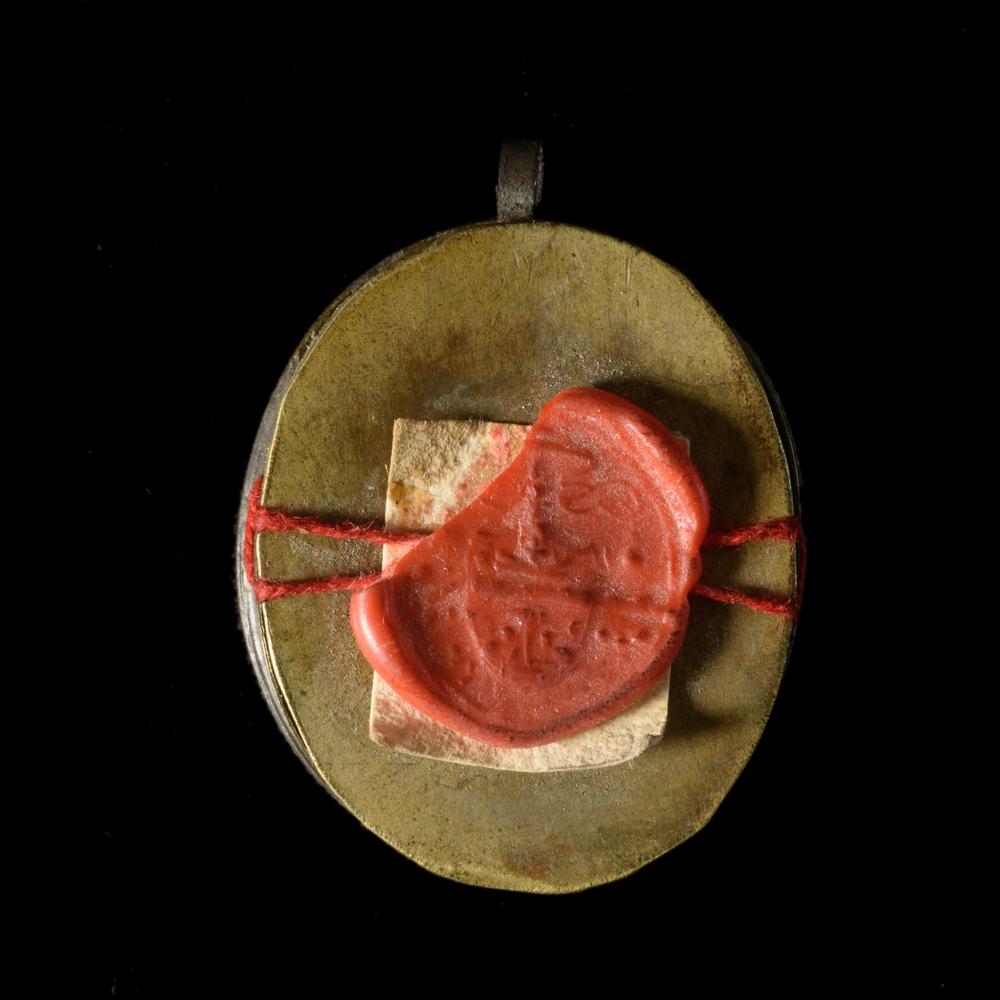
Ecclesiastical seal and silk threads present.
PERIOD : 18th century
DIMENSION : 3.5 cm × 3 cm
SIZE : 1.4" × 1.2"
Relics associated with the cloths of Christ’s Infancy are among the rarest in the Christian world, due to their textile nature and their extremely limited transmission. From the earliest centuries, these fabrics were preserved in a small number of major sanctuaries, notably in Rome and in Aachen.
Their rarity is explained by their fragility and by a highly controlled dissemination. The fragments found in antique reliquaries result from exceptional transmissions, often linked to high-ranking ecclesiastical circles.
To possess such a relic is to hold a direct testimony of the mystery of the Nativity, which gives this object a particularly high historical, spiritual, and collectible value.