RELIC OF SAINT PETER OF VERONA, PATRON SAINT OF THE INQUISITORS
RELIC OF SAINT PETER OF VERONA, PATRON SAINT OF THE INQUISITORS
Our prices are in euros, the prices converted in dollars or other currencies can vary according to the rate.
Free shipping – fast and secure delivery.
ref: #RK00-969Couldn't load pickup availability
Rare and very elegant oval reliquary from the 18th century, in gilded brass, containing a first-class relic – Ex Ossibus of Saint Peter of Verona, Martyr –, presented in an architectural composition of remarkable decorative quality.
This superb reliquary is distinguished by its oval gilded brass mount with a scrolled border, retaining its original suspension loop. The front is protected by its original antique glass, behind which unfolds an exceptional and particularly refined decor.
The interior consists of a sumptuous crimson red silk background, enhanced by a miniature architecture entirely made of gilded paper rolls (paperoles), cannetilles, metallic threads, and silver applications. Two twisted columns frame a small edifice surmounted by a richly ornamented pediment with garlands, palmettes, and radiating motifs, evoking a true Baroque altar. This staging perfectly illustrates the craftsmanship of 18th-century convent workshops.
At the center of this architecture is presented the relic, carefully arranged in its original mounting, highlighted by a radiating decor symbolizing celestial glory.
The handwritten inscription on the lower phylactery reads:
Ex Digito S. Petri M.
Ex Digito Sancti Petri Martyris
Translation: From the Finger of Saint Peter the Martyr.
This inscription identifies a relic from the finger of Saint Peter Martyr of Verona, a 13th-century Dominican, famous for his preaching against heresies and his martyrdom in 1252.
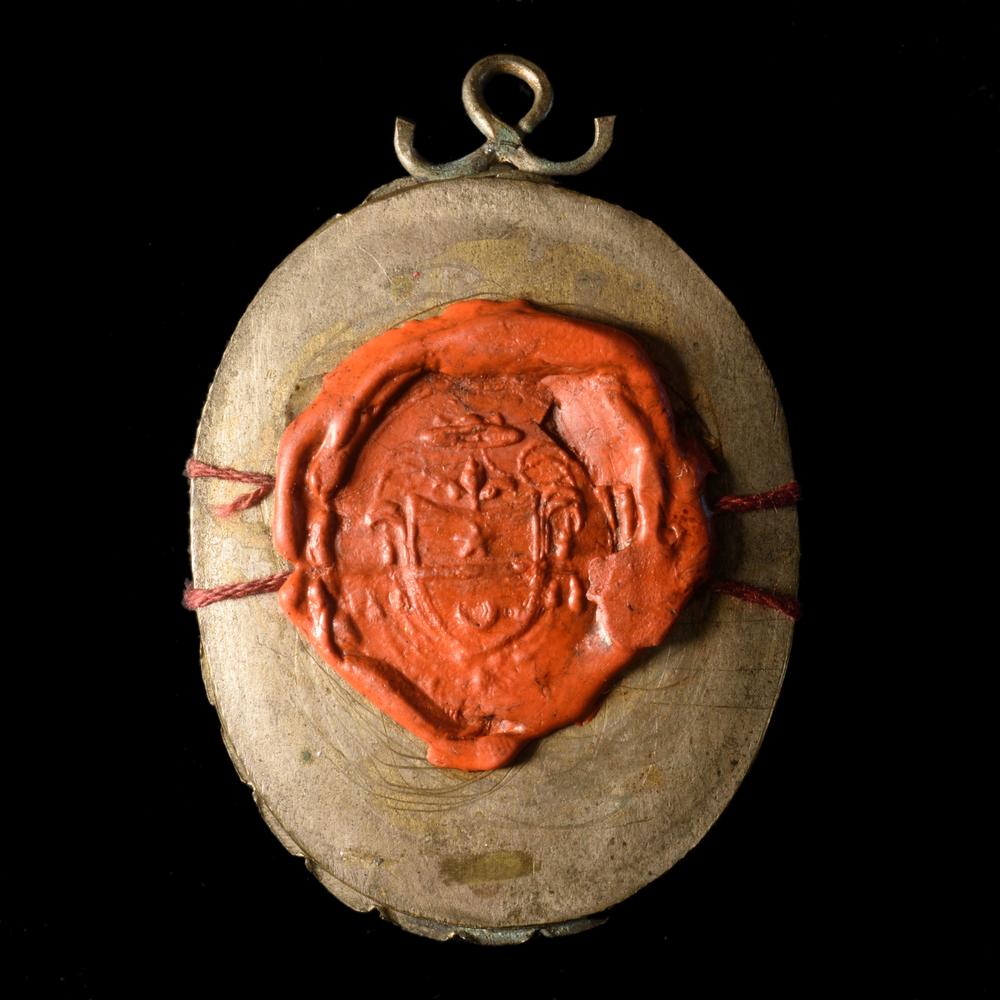
The reverse retains its ecclesiastical wax seal in red wax, threaded with its original silk threads, attesting that the reliquary has never been opened since its official sealing.
The richness of this Baroque composition recalls the reliquaries preserved in Dominican convents, where the relics of Saint Peter Martyr held a place of honor. As pontifical Inquisitor and martyr in the fight against heresies, he was one of the most emblematic figures of the Order of Preachers.
Very good condition.
Original glass.
Reliquary unopened.
Ecclesiastical seal intact and original silk threads present.
PERIOD: 18th century
DIMENSIONS: 5.5 cm × 4.5 cm
SIZE: 2.2" × 1.8"
Saint Peter Martyr of Verona, also known as Peter of Verona (Petrus Martyr), was born around 1205 into a family sympathetic to Catharism. Converted to the Catholic faith, he entered the Order of Preachers founded by Saint Dominic at a very young age and quickly became one of the most famous preachers of his time.
Personally commissioned by the Pope to combat the heresies spreading in northern Italy, he was appointed Pontifical Inquisitor for Lombardy. His mission was to defend Catholic orthodoxy against the Cathar movement, making him one of the most emblematic figures of the emerging medieval Inquisition. His activity aroused deep hatred among his opponents.
On April 6, 1252, while traveling between Como and Milan, Peter Martyr was attacked by assassins sent to silence him. Struck with a sickle, he continued, according to tradition, to profess his faith until his last breath, tracing the word “Credo” on the ground with his own blood before dying.
His death made him the most famous martyr of the Dominican Order. Because of his role as Pontifical Inquisitor, he is traditionally considered the patron saint of inquisitors, ecclesiastical judges, and Dominicans. His canonization by Pope Innocent IV took place in 1253, less than a year after his assassination — one of the fastest in the entire history of the Church.
The relics of Saint Peter Martyr were particularly venerated in Dominican convents, where they symbolized the defense of the Catholic faith against heresy. 18th-century reliquaries preserving an Ex Digito relic (“from the finger”), combined with such a rich Baroque composition and an intact ecclesiastical seal, are today particularly sought-after pieces by collectors of religious art and the history of the Inquisition.