RELIC OF SAINT LIBERATA WITH DOCUMENT
RELIC OF SAINT LIBERATA WITH DOCUMENT
Our prices are in euros, the prices converted in dollars or other currencies can vary according to the rate.
Free shipping – fast and secure delivery.
ref: #RK00-882Couldn't load pickup availability
Imposing oval reliquary from the 19th century in gilded brass, richly surrounded by a setting of diamond-cut glass cabochons, containing a notable relic: a bone fragment of Saint Liberata, Martyr.
The relic, carefully arranged at the centre of the reliquary, rests on a deep red velvet ground and is identified by an old handwritten label: “Ste. LIBERATE. M.” (abbreviation of Sancta Liberata Martyr).
Around the bone fragment unfolds a delicate decoration of gilded metal-leaf flowers, enhanced with small green pearls, evoking a sacred radiance that emphasises the dignity of the virgin martyr and the importance of the relic.
The red velvet, the traditional colour of the blood of Christ and of the martyrs, heightens the sacrificial dimension of the object and highlights the whiteness of the bone, creating a visual contrast of great nobility.
The original glass protects the ensemble in an elegant mounting typical of the second half of the 19th century.
On the reverse, the reliquary retains its ecclesiastical red wax seal, crossed by silk sealing threads, attesting that it has never been opened since its authentication.
The relics of Saint Liberata occupy an important place in the history of her cult. After her martyrdom in Aquitaine, her body was first received at the church of Saint-Jean de Mazères, where it remained the object of deep local veneration. In the 14th century, the Bishop of Tarbes ordered the shrine to be transferred to a chapel of the Abbey of Saint-Sever de Rustau. During the Wars of Religion, in order to avoid profanation, the shrine was brought back to Mazères, where the saint’s body was devoutly preserved and where it is still honoured today.
A notable part of her relics was long kept at the Abbey of Grand-Selve. In the 17th century, the abbot entrusted an important portion to the inhabitants of Sainte-Livrade in the Agenais region, who adopted Saint Liberata as their patron saint and gave her name to their town. The cult spread throughout Aquitaine, and the relics were especially invoked by women in childbirth. Other fragments, transmitted according to ancient custom, were distributed among several sanctuaries: some are mentioned at the Cathedral of Sigüenza in Spain, others in Italy in the traditions of Pizzone. This controlled dispersion, faithful to popular devotion, attests to the wide and constant veneration of the saint across the centuries.
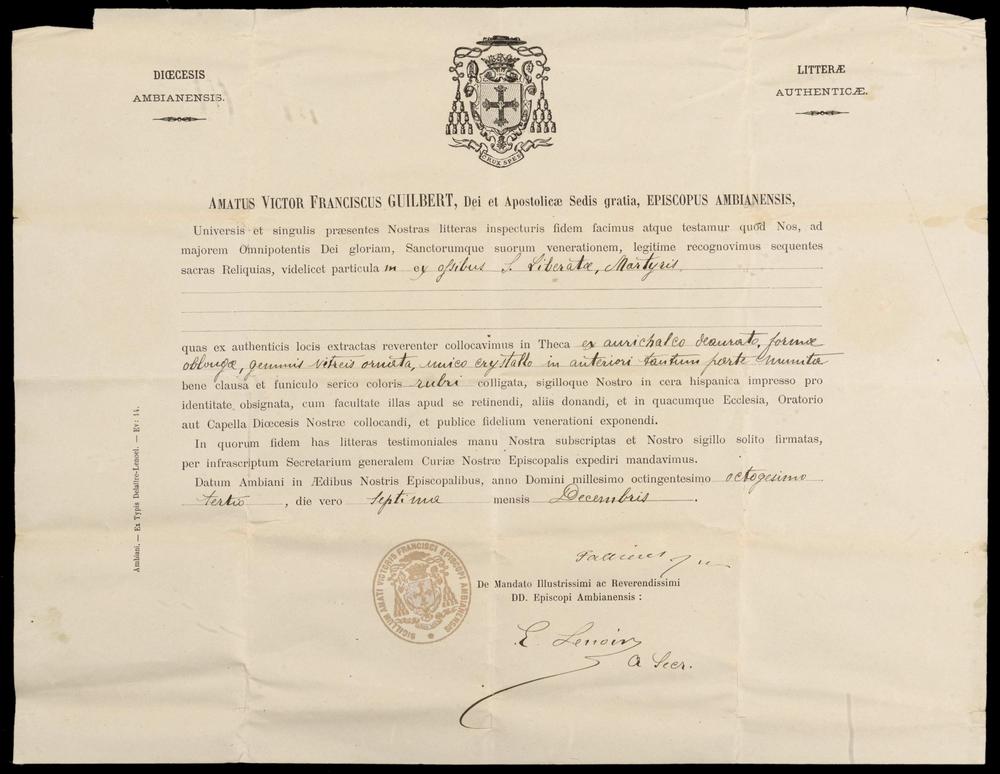
The reliquary is accompanied by an original authentic document issued by Aimé-Victor-François Guilbert, Bishop of Amiens in 1880, certifying the authenticity of the relics contained within.
“Diocese of Amiens
We, Amatus Victor François Guilbert, by the grace of God and of the Apostolic See, Bishop of Amiens,
make known to all and each who shall read or examine these present letters that, for the greater glory of Almighty God and for the veneration of His Saints, we have legitimately recognised the following relics, namely:
a portion of the bones of Saint Liberata, Martyr.
These relics, taken from authentic places, we have piously placed in an oval reliquary of gilded copper, adorned on the front with a single crystal glass, well closed and bound with a red silk cord, sealed with our seal in Spanish red wax bearing our inscription, with permission to keep them in one’s possession, to give them, and to expose them for the public veneration of the faithful in any Church, Oratory or Chapel of our Diocese.
In testimony whereof we have ordered that these testimonial letters be written by hand by our General Secretary of the Curia, signed by our own hand and provided with our customary seal.
Given at Amiens, in our Episcopal residence, in the year of Our Lord one thousand eight hundred and eighty, on the seventh day of the month of December.
By order of His Excellency, the Bishop of Amiens
Signed: E. Lenoir, Secretary.”
PERIOD : 1880
DIMENSIONS : 15.5 cm × 8.5 cm
SIZE : 6.1" × 3.4"
Saint Liberata, also called Livrada, was born in the 4th century in Spain into a family hostile to Christianity. By divine grace, however, she received the faith and a Christian upbringing. Refusing to sacrifice to the pagan gods, she secretly fled with her sisters Quiteria and Gemma to Aquitaine, where the three of them converted many pagans. Informed of their activity, their father Catilius denounced them to the governor Moderius, who had them tortured and then beheaded. Liberata suffered her martyrdom in the forest of Montus, in the Diocese of Tarbes.