RELIC OF SAINT CHRISTINA
RELIC OF SAINT CHRISTINA
Our prices are in euros, the prices converted in dollars or other currencies can vary according to the rate.
Free shipping – fast and secure delivery.
ref: #RK00-837Couldn't load pickup availability
Rare oval reliquary in molded silver, closed with its original glass front, containing an authenticated relic of Saint Christina, Martyr (identified by the handwritten label “no / S. Christ. m.”).
The relic — an ancient fragment of fibrous material, most likely an ex ossibus — rests on a ground of unbleached fabric, time-worn and naturally patinated. It is surrounded by a delicate radiating decoration of silvered metallic threads, evoking a halo intended to emphasize the sacred nature of the preserved fragment.
The old label, written in red ink, displays an abbreviation typical of 18th-century reliquaries:
-
“S. Christ.” : Sanctae Christinae
-
“m.” : martyris
-
“no” placed above: a frequent additional notation meaning nomine or notatus — indicating that the relic is designated “in the name of Saint Christina, Martyr.”
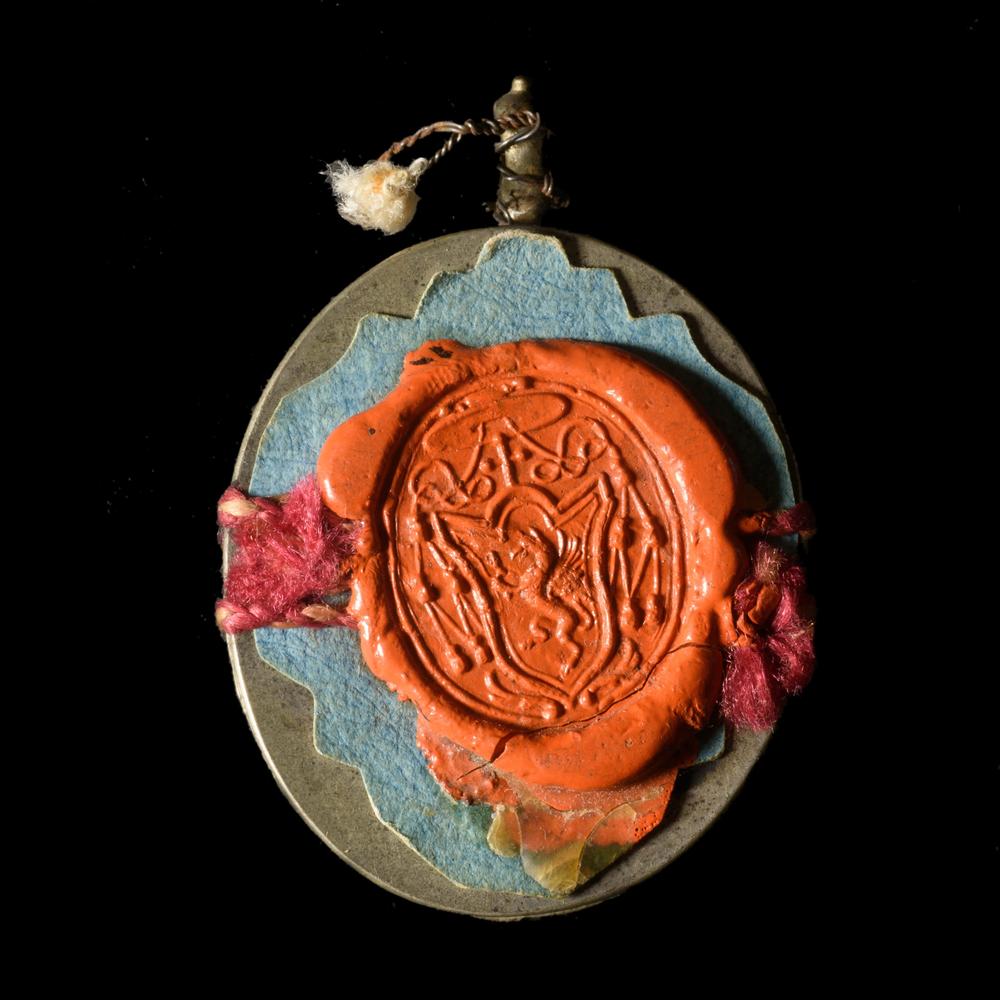
The reliquary retains its original ecclesiastical seal and perfectly intact silk threads, formal proof that it has never been opened since its creation and that it is an authenticated piece.
Truly ancient relics of Saint Christina are relatively rare: the very early cult of this virgin martyred at Bolsena led to a gradual dispersion of her fragments from the Middle Ages onward, so that only a small number of reliquaries sealed by ecclesiastical authorities survive in private collections.
PERIOD : 18th century
DIMENSIONS : 4 cm × 3.5 cm
SIZE : 1.6″ × 1.4″
Venerated since the earliest centuries, Saint Christina is said to have come from a pagan family in the region of Bolsena. At a very young age, she embraced the Christian faith despite the violent opposition of her father, who subjected her to various torments in an attempt to force her to renounce Christ.
Ancient accounts relate that she miraculously survived the wheel, fire, and drowning, before finally dying pierced by arrows. Her tomb quickly became a place of pilgrimage, and her cult spread widely throughout Italy and across Europe.
She is commemorated on July 24, as a symbol of purity, heroic courage, and complete fidelity to the Christian faith.