RARE RELIQUARY OF THE VEIL OF THE VIRGIN
RARE RELIQUARY OF THE VEIL OF THE VIRGIN
Our prices are in euros, the prices converted in dollars or other currencies can vary according to the rate.
Free shipping – fast and secure delivery.
ref: #RK00-907Couldn't load pickup availability
Rare 18th-century reliquary in silver with a glass front containing a precious Marian relic.
This circular reliquary features a mount in old silver, now heavily patinated, whose reliefs and borders retain the marks of time. The perimeter is adorned with a crown of pleated metallic cannetille work forming a radiant collar, characteristic of certain conventual Baroque productions from the second half of the eighteenth century.
The slightly convex and patinated glass front protects a richly structured interior composition. The background consists of a deep red textile, framed by two bluish lateral reserves creating a liturgical chromatic contrast.
At the center, the relic is presented in the form of a small pale fibrous fragment, fixed on a rectangular parchment support.
Two handwritten phylacteries identify the relic :
“Ex Velo”
“B. M. V.”
→ Ex Velo Beatae Mariae Virginis
Translation : From the veil of the Blessed Virgin Mary
It is a Marian textile contact relic, originating from the veil attributed to the Virgin Mary — a category among the most venerated and historically sought-after within Catholic devotion.
Good condition with original glass.
Unopened.
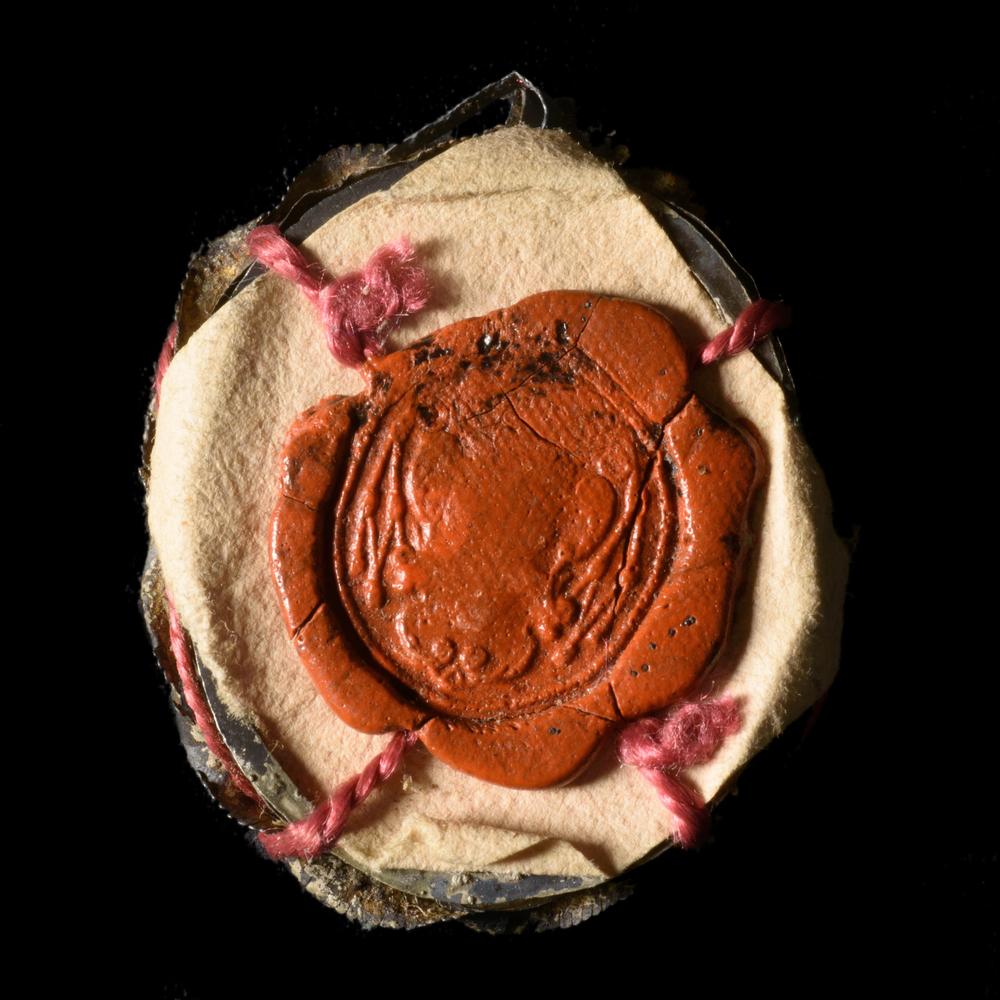
Ecclesiastical seal and silk threads present.
PERIOD : 18th century
DIMENSION : 3 cm × 2.5 cm
SIZE : 1.2" × 1"
Through this fragment of the veil, the faithful are invited to contemplate the maternal closeness of Mary — not only as Queen of Heaven in her theological glory, but as a protective mother symbolically enveloping humanity beneath her spiritual mantle. In Christian tradition, the veil far exceeds its simple vestimentary function : it is the very attribute of the Virgin, a sign of purity, consecration and sacred withdrawal. Connected to her personal intimacy, it refers both to her most tangible earthly presence — the woman of Nazareth in her daily life — and to the Mother of God in the mystery of the Incarnation.
Yet this devotional significance is accompanied by a historical dimension of extreme rarity. Marian textile relics — and even more those attributed to the veil — rank among the rarest preserved within Christendom. Their perishable nature explains the disappearance of most original fabrics, carefully safeguarded for centuries in a small number of major sanctuaries and only very rarely fragmented. Each transmitted particle thus belongs to a complex history of preservation, translations and ecclesiastical gifts.
To possess or venerate a fragment of the veil meant, for religious communities as well as for the faithful, to draw materially closer to a maternal presence regarded as protective and intercessory. The fabric thus becomes a relic of gentleness, but also a relic of memory — a tangible trace of a figure whose authenticated material remains are exceptionally rare and highly sought after.