MANUALE RITUUM ECCLESIASTICORUM – RITES AND EXORCISMS 1687
MANUALE RITUUM ECCLESIASTICORUM – RITES AND EXORCISMS 1687
Our prices are in euros, the prices converted in dollars or other currencies can vary according to the rate.
Free shipping – fast and secure delivery.
ref: #RK00-891Couldn't load pickup availability
Catholic Ritual – Bayeux, 1687
Copy presented by the Bishop of Bayeux to the Cistercian Abbey of Val-Richer.
Printed in 1687, this Manuale Rituum Ecclesiasticorum is an early Catholic ritual book nearly four centuries old, conceived for use rather than study. It was never intended as a volume to be read in silence, but as a book to be opened, held, and made to speak. Its pages were not devoted to theological speculation, but to the daily practice of rites believed to act upon both the visible and invisible worlds.
The present copy bears, on its opening pages, a handwritten dedication dated to the very year of its publication: Pro Valle-Richerii / Ex dono D. Francisci de Nesmond / Episcopi Bajocensis 1687. This inscription attests that the book was personally offered by the Bishop of Bayeux to the Cistercian Abbey of Val-Richer. The gift committed the volume to real use: it was not preserved as a specimen, but entrusted to a religious community for practical application.
François de Nesmond, bishop for more than half a century, was among the most rigorous representatives of post-Tridentine discipline. By having this ritual printed and then offering it to an abbey, he transmitted authority, method, and language. The book thus became an instrument of spiritual power, a direct link between the bishop and those charged with performing the rites in daily life.
The contents of the Manuale reflect this vocation. It includes the sacraments, blessings, funerals, notated liturgical chants, as well as prayers and formulas of exorcism intended to be pronounced in the face of what were called demonic influences. These pages are neither symbolic nor allegorical: they describe gestures, words, and precise sequences designed to expel, purify, and protect. The ritual of the domus infestata, the troubled house, situates this book within a practice in which evil was not abstract, but localized, named, and confronted.
The very materiality of the volume preserves this memory. The contemporary brown calf binding is worn, rubbed, and marked. Blunted corners, traces of time, and signs of handling speak of a book frequently opened, moved, and used in contexts that were sometimes grave. These are not defects, but signs of a long, silent, and repeated life.
After the disappearance of the Abbey of Val-Richer during the Revolution, the work remained within the ecclesiastical sphere, as evidenced by the stamp of the Library of the Grand Seminary of Caen. It thus crossed the centuries without leaving its original sphere of use, before entering today into another space of contemplation.
This book is not merely a witness to the past. It is an ancient ritual object, charged with gestures, words, and beliefs — a volume once held in hands convinced that the words written on its pages could act upon fear, death, and what was perceived as evil.
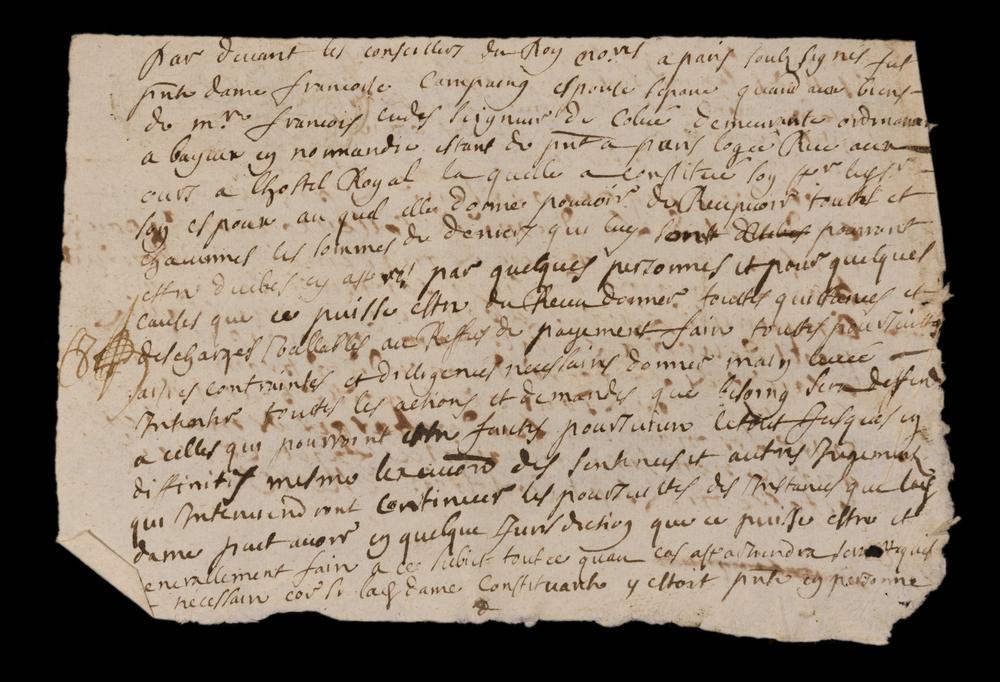
Accompanying manuscript document
Preserved inside the volume at the time of its rediscovery, an old handwritten letter accompanies this ritual. Written in French in a cursive hand characteristic of the late seventeenth or very early eighteenth century, it refers to commitments, obligations, and decisions taken between spouses, in language blending legal, moral, and religious registers. This document, clearly contemporary with the book’s use, is not a decorative or later addition, but a direct testimony to the human and spiritual matters for which such a ritual was consulted. Its presence within the volume reinforces the lived character of the whole and concretely illuminates the context in which this Manuale Rituum was used, where the written word, ritual action, and personal commitment were closely intertwined.
Condition and bibliophilic description
Quarto (in-4), bound in contemporary full brown calf, showing the expected marks of a genuinely used early ritual book. The binding, authentic and unrestored, displays rubbing, blunted corners, and light old handling marks, without structural weakness. The boards remain firm, the raised-band spine is sound. The interior is clean, with sharp printing, a few old stabilized traces of dampness, and no impairment of legibility. The pages containing musical notation and ritual formulas, including those relating to exorcisms, are well preserved. The whole presents a homogeneous and honest patina, bearing witness to prolonged liturgical use consistent with the book’s original purpose. A solid and well-preserved example for a seventeenth-century ritual book.
Format : quarto (in-4), 448 pages
Dimensions : approx. 25 × 19 cm
Size : approx. 9.8" × 7.5"
Language : Latin
Date : 1687
Binding : contemporary full brown calf, raised-band spine