MALLEUS MALEFICARUM (1610) – The Hammer of Witches
SOLD — This object is now part of a private collection
MALLEUS MALEFICARUM (1610) – The Hammer of Witches
Our prices are in euros, the prices converted in dollars or other currencies can vary according to the rate.
Free shipping – fast and secure delivery.
ref: #RK00-B254Couldn't load pickup availability
Malleus Maleficarum – Treatise on demonology and judicial repression
Catholic Europe, 1610
Printed in 1610, this copy of the Malleus Maleficarum belongs to the long afterlife of a text written at the end of the fifteenth century and which, over the decades, became one of the doctrinal and legal foundations of the institutional struggle against practices deemed demonic. By this date, the Malleus was no longer a polemical novelty, but a work firmly integrated into the intellectual arsenal of ecclesiastical and civil authorities, used to define, classify, and legally frame accusations of witchcraft and alliances with the demon.
Entitled Malleus Maleficarum — literally “The Hammer of Witches” — this work is also known, in historical tradition and the collective imagination, as the witches’ book, owing to its central role in the definition and judicial repression of practices judged to be demonic.
The volume takes the form of a large in-folio, a format characteristic of books of power intended for collective consultation and institutional use. It is neither a book for private reading nor a devotional manual, but a work designed to be placed, opened, consulted, and discussed within a judicial, academic, or ecclesiastical setting. Its size, thickness, and weight convey a function of authority: the text it contains does not seek to console or protect, but to judge, classify, and condemn.
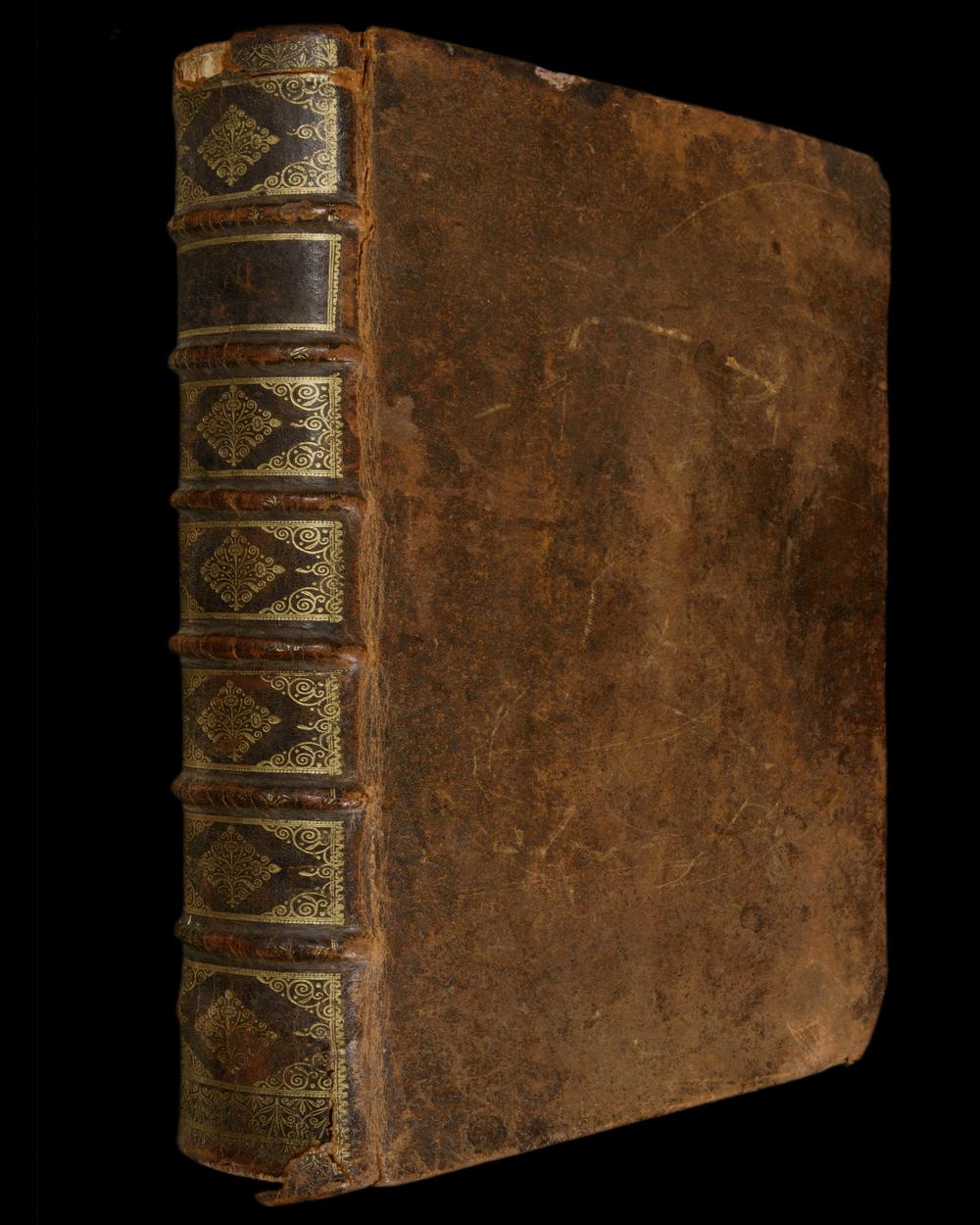
The contemporary calfskin binding, with raised bands and gilt compartments, displays a deep and even patina, bearing witness to long and sustained use. The deliberate absence of a visible title on the spine, a frequent practice in institutional libraries of the period, gives the volume an almost anonymous character, in which the book no longer exists as an author’s work but as an instrument. It is a working object, integrated into a broader corpus of legal and theological texts intended to regulate repressive action in the face of what was perceived as the irruption of evil into Christian society.
Unlike ritual manuals of exorcisms and blessings, the Malleus Maleficarum does not act through sacramental speech or ritual. It intervenes upstream, on the terrain of law, procedure, and theological argumentation. It constitutes the judicial dimension of the struggle against the demon, where other books seek to repel or constrain him through ritual formulas. It does not drive out evil: it designates it, defines it, and condemns it.
Across its pages unfolds a world in which fear is codified, suspicion becomes method, and confession — often obtained under coercion — seals the fate of bodies and souls. The demon is never abstract here: he is conceived as an active presence, concealed at the heart of Christian society, and human justice is charged with acting as a relay of divine justice. The Malleus thus accompanies a judicial practice in which torture is accepted as an instrument of truth, and repression is understood as a spiritual necessity.
Through its format, its date, and its materiality, this 1610 Malleus Maleficarum remains a major testimony to the way in which Catholic Europe of the early seventeenth century conceived and organized the repression of practices judged to be demonic. It fully belongs to the history of books of power: works designed not to describe evil, but to enable institutions to name it, encircle it, and strike it.
Bibliophilic description
In-folio volume. Contemporary calfskin binding with raised bands and gilt compartments, even patina, old use consistent with prolonged institutional consultation. Interior in good readable condition for a legal and doctrinal work of the early seventeenth century.
The binding is deliberately devoid of a title, as is the spine, in accordance with a practice frequently observed in institutional and ecclesiastical libraries of the early seventeenth century. The volume was not intended to be visually identified on a private shelf, but recognized by its place within a legal and theological corpus.
This absence of inscription gives the volume an almost anonymous and impersonal character: the book does not assert itself as an author’s work, but as an instrument of work and authority, integrated into a body of normative texts intended to frame judicial and doctrinal action. The sober and functional binding favors durability and collective use over any desire for ostentation.
Format : in-folio
Dimensions : approx. 37 × 25 cm
Size : approx. 14.5" × 9.8"
Language : Latin
Date : 1610
Binding : contemporary calfskin binding with raised bands and gilt compartments