LOCUPLETISSIMUS THESAURUS Exorcisms, Blessings and Conjurations 1744
SOLD — This object is now part of a private collection
LOCUPLETISSIMUS THESAURUS Exorcisms, Blessings and Conjurations 1744
Our prices are in euros, the prices converted in dollars or other currencies can vary according to the rate.
Free shipping – fast and secure delivery.
ref: #RK00-905Couldn't load pickup availability
Blessings, Conjurations and Exorcisms
Operative Catholic Ritual – 18th century
Printed in 1744, the Locupletissimus Thesaurus is an early Catholic ritual manual conceived for direct use in situations considered spiritually grave. It is neither a book for reading, nor a speculative treatise, nor a devotional compilation. This work was designed to be opened in moments of urgency, held firmly in the hand, and consulted at the very moment when action had to be undertaken.
Written by Gelasius de Cilia, a Canon Regular of Saint Augustine, the book presents itself as an authorised and methodical synthesis of ritual practices recognised by the Catholic Church. The term Thesaurus is not metaphorical: it designates a structured repository of blessings, conjurations, exorcisms and rites, covering a wide range of concrete situations faced by the clergy: persistent illnesses, maleficent influences, possessions, unexplained disturbances, afflictions attributed to the action of the demon.
The text does not merely set out prayers. It frames ritual action in its entirety: the required dispositions of the priest, the gestures to be performed, the order of the words, and the progression of the rite. The demon is regarded as a personal, active and hostile reality, capable of afflicting, disturbing and possessing. The rites proposed are neither symbolic nor allegorical. They are intended to constrain, repel and expel a presence considered real, through codified words and prescribed gestures.
Exorcisms occupy a central place in the work (nearly half of the book), particularly those intended for persons described as maleficiatae, affected by harmful spells. They take the form of direct commands, injunctions pronounced with authority, aimed at forcing the demon to withdraw. The Locupletissimus Thesaurus fully belongs to the applied demonology of the early modern period, in which exorcism constituted an institutional, necessary and regulated response to the action of the Evil One.
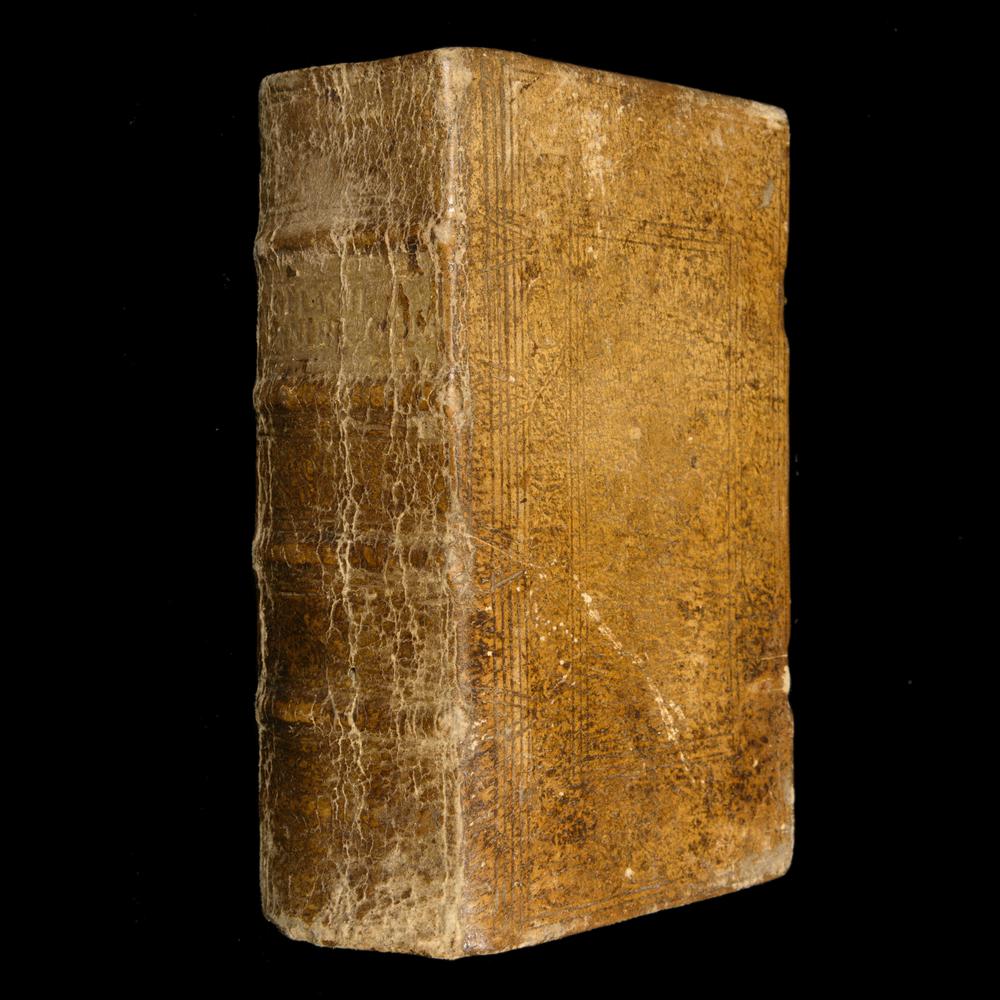
The present copy is distinguished by an exceptionally pronounced state of use, which constitutes one of its most significant features. The period leather binding is deeply worn and cracked by time and repeated handling. The metal clasps are incomplete, one of them missing or broken. The binding is partially detached. The edges are soiled. The pages bear strong finger marks, particularly visible at the lower margins of the leaves, where the volume was grasped and firmly held.
This wear is neither accidental nor diffuse. It corresponds precisely to the areas of contact during intensive ritual use, often while standing or at the bedside, in situations of tension where the priest had to hold the book in one hand while pronouncing the formulas. The final pages show old traces of damp, without major impact on legibility, testifying to prolonged use in environments that were neither clean nor controlled.
The condition of this volume is that of an instrument pushed to the limits of its functional purpose. This book was not preserved: it was used. It was opened, held, and handled with both hands during demanding rites, in situations where urgency and confrontation were considered real. The very material of the volume — leather, paper, ink — retains the direct trace of these repeated uses.
By its scope, its operative character and the silent violence of its wear, the Locupletissimus Thesaurus constitutes a rare and particularly eloquent testimony to the way in which the Catholic Church regulated and implemented practices of exorcism and spiritual protection in the 18th century. This is not a book describing the struggle against evil. It is an instrument designed to take part in it, shaped by action and by the repetition of the rites it contains.
Condition and bibliophilic description
12mo volume, editio sexta. Period full leather binding, heavily worn and cracked, metal clasps incomplete. Binding partially detached. Edges soiled. Pages intensively handled, with repeated signs of use, particularly visible at the lower margins of the leaves. Old damp stains at the end of the volume, without major impact on legibility. Complete copy, still structurally sound and usable, whose condition reflects real and prolonged ritual use.
Format : 12mo 778 pages
Dimensions : approx. 17.5 × 11 cm
Size : approx. 6.9" × 4.3"
Language : Latin
Date : 1744
Binding : period full leather with clasps