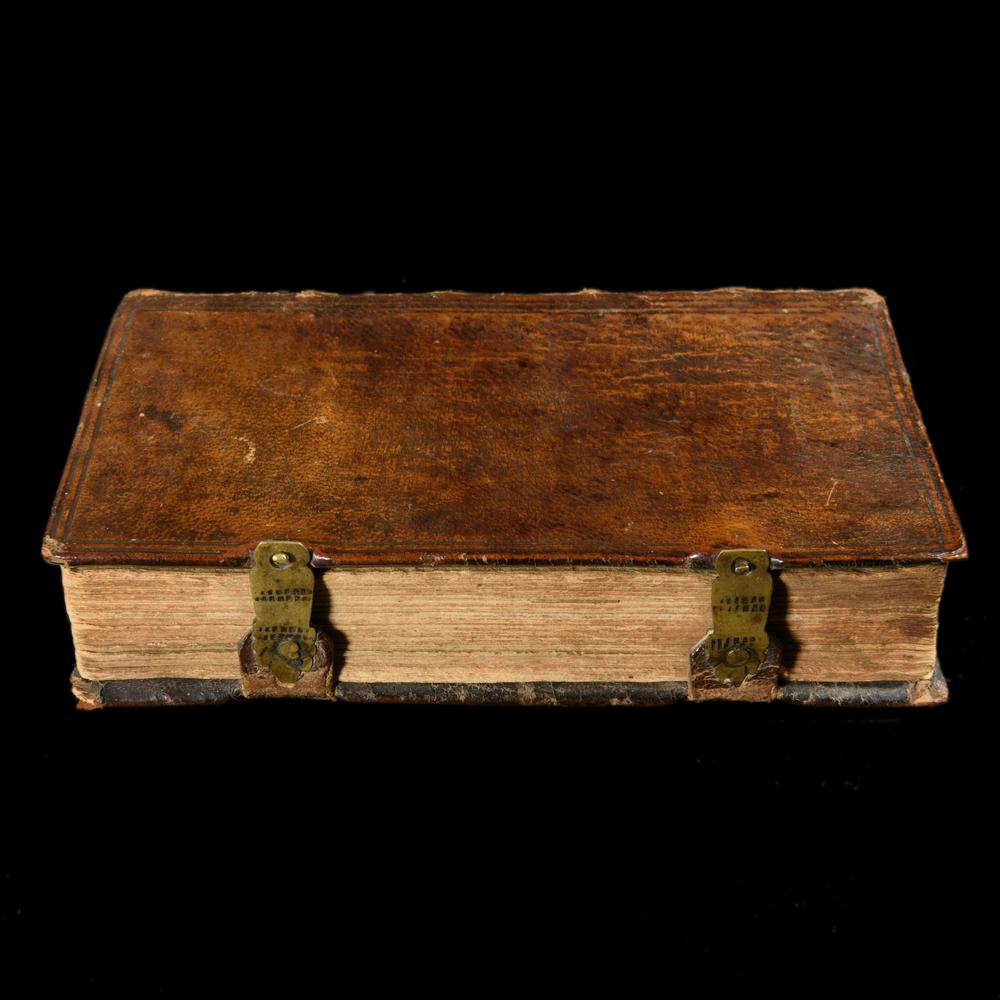
LIBELLUS INFIRMORUM – Rites and Exorcisms, 1737
LIBELLUS INFIRMORUM – Rites and Exorcisms, 1737
Our prices are in euros, the prices converted in dollars or other currencies can vary according to the rate.
Free shipping – fast and secure delivery.
ref: #RK00-889Couldn't load pickup availability
Blessings and Exorcisms.
Operative Catholic Ritual Manual – 18th century
This ritual manual was printed for the direct use of priests, and not for silent reading or preservation. Entitled Libellus Infirmorum Benedictionum et Exorcismorum and printed in 1737, this work fully belongs to the official religious practice of the 18th century. It is rooted in a context in which the rite is not conceived as a commentary on evil, but as an immediate response to its presence.
Written by the Capuchin friar Martinus Cochemensis, this manual gathers prayers, blessings, and formulas of exorcism recognized by the Catholic Church, intended to be pronounced in situations considered spiritually dangerous. The demon is regarded here as a personal, active, and effective reality: capable of afflicting bodies, disturbing souls, attaching itself to places, and taking possession of persons. Exorcism does not appear as an exceptional practice, but as a necessary pastoral tool, integrated into the Church’s ordinary response to the action of the Evil One.
The formulas contained in this book take the form of direct commands, explicit injunctions, and invocations pronounced with authority. They are intended to be spoken aloud, according to a precise order, within a strictly defined ritual framework. Nothing is left to allusion or interpretation: the words are structured to be enacted, within a sequence designed to produce action.
The present copy bears clear marks of real and repeated use. Its small format, its period full-leather binding fitted with metal clasps, as well as the ancient and even patina of the pages, indicate a volume designed to be carried on one’s person, frequently opened, and consulted in action. The dense typography, austere layout, and complete absence of explanatory apparatus reflect an exclusively practical function: this is a ritual working tool, intended to be handled rather than read.
This manual is further distinguished by its personal character. An old handwritten inscription appears on the title page: “Ad usum P. Theophile Kagerlauer(d)”, a Latin formula meaning “for the use of Father Theophile Kagerlauer.” Written in a cursive hand characteristic of the 18th century, this inscription attests to an individual clerical provenance and confirms that the book was intended for the daily use of a specific religious. It anchors this volume in a lived, repeated, and assumed practice. The Germanic area suggested by this name is consistent with the place of publication (Mainz / Frankfurt) and with the Capuchin author.
The institutional framework of this manual is fully affirmed. The blessings and exorcisms it contains belong to a recognized tradition, transmitted and supervised by a religious order, in accordance with post-Tridentine Catholic discipline. This book is an authorized instrument, entrusted to a priest invested with real spiritual authority, exercised in the face of a demonic presence regarded as objective.
The Libellus Infirmorum today constitutes a precise material testimony of institutional exorcism in the 18th century. It preserves the trace of a world in which the struggle against the demon was considered real, necessary, and urgent, and in which the words written on these pages were not meant to be meditated upon, but to be spoken aloud and put into action.
Condition and bibliophilic description
Complete copy, with no losses or missing leaves. Original period full-leather binding, showing normal wear from use with rubbing and signs of age, without modern restoration. Metal clasps present. Old paper with uniform patina, foxing, and light traces of use consistent with age. Clear and legible printing. A solid volume, well preserved for an 18th-century ritual manual.
Format : in-12 (duodecimo), 292 pages
Dimensions : approx. 14 × 9 cm
Size : approx. 5.5" × 3.5"
Language : Latin
Date : 1737
Binding : period full leather, metal clasps