LIBELLUS INFIRMORUM – Rites and Exorcisms, 1692
LIBELLUS INFIRMORUM – Rites and Exorcisms, 1692
Our prices are in euros, the prices converted in dollars or other currencies can vary according to the rate.
Free shipping – fast and secure delivery.
ref: #RK00-944Couldn't load pickup availability
Operative Catholic Ritual Manual – 17th Century
Blessings, Conjurations and Exorcisms
Practical sacerdotal handbook intended for the administration of the sacraments and the struggle against demonic influences
Printed in Frankfurt in 1692, the Libellus Infirmorum belongs to that category of religious works conceived not for simple reading, but for immediate action. This small manual stands within the tradition of ritual books intended to accompany the priest in situations considered spiritually dangerous: severe illness, agony, unexplained disturbances, natural disasters, or phenomena attributed to the intervention of the Devil.
Written by the Capuchin Martinus Cochemensis, an active preacher in the German-speaking world, the work gathers a structured collection of blessings, prayers, and exorcism formulas recognized within Catholic practice during the early modern period. The rites contained within are not matters of abstract theological speculation; they constitute concrete responses to situations regarded as urgent, in which ritual speech was expected to act directly upon the body, the soul, or the surrounding space.
The Devil is presented here as a personal and active presence, capable of afflicting individuals, disturbing places, and intervening in the events of the visible world. Exorcism therefore appears as a necessary pastoral act, integrated into the ordinary exercise of priestly ministry. The formulas take the form of direct injunctions, commands pronounced with authority, and invocations intended to restore spiritual order. The text was designed to be spoken aloud according to a precise progression, not silently contemplated.
The very material nature of the volume confirms this operative purpose. Its reduced format allowed it to be easily carried during travel. The dense typography, austere layout, and absence of doctrinal commentary reveal a strictly practical function: this was a ritual working tool intended to be handled in action, sometimes in grave or distressing circumstances.
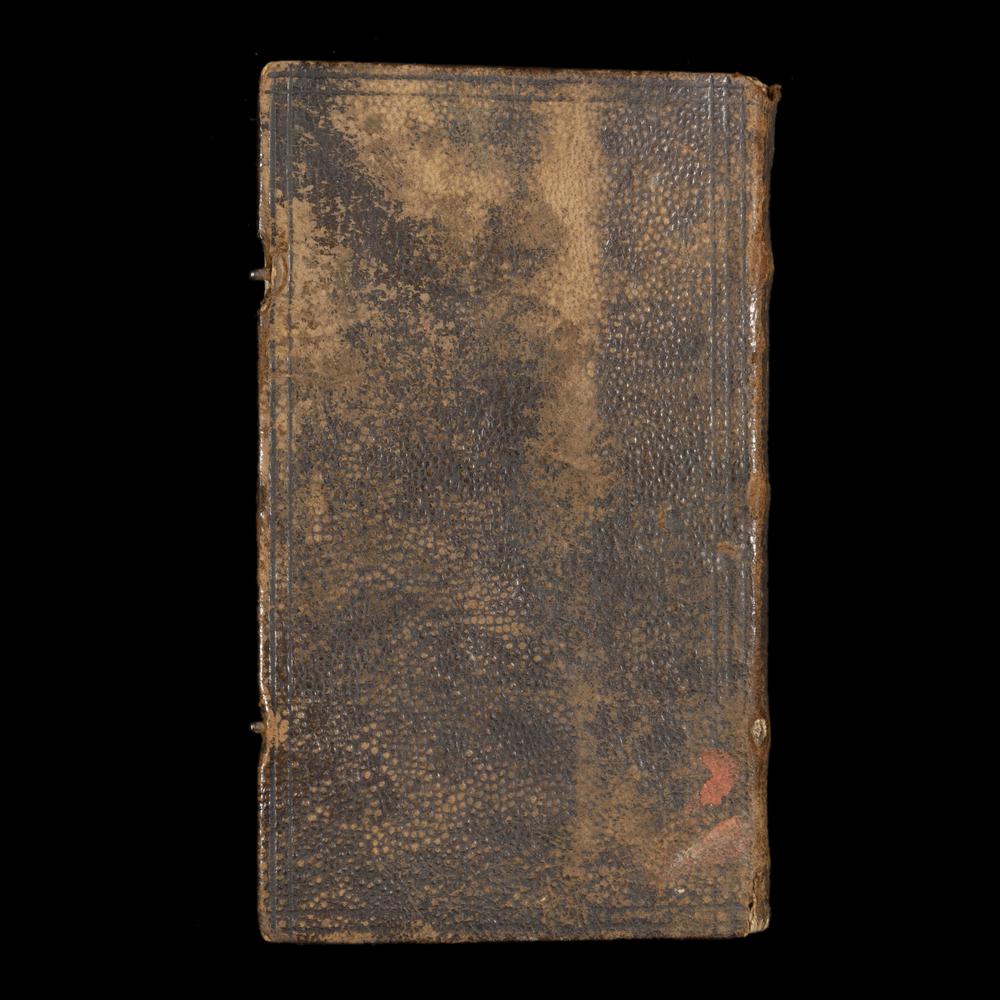
The present copy preserves in a particularly evocative manner the traces of this life of use. The contemporary brown leather binding, deeply patinated, displays rubbing, wear, old damages, and remnants of clasps now missing. These alterations are not mere defects: they testify to prolonged handling, real circulation, and repeated consultation across several generations.
An old German sacristy stamp together with handwritten inscriptions further reinforce this ecclesiastical provenance and anchor the volume within lived religious practice. The book thus appears as an authentic ritual object, one that accompanied gestures, spoken formulas, and beliefs in a world where the struggle against evil was regarded as a concrete necessity.
More than three centuries old, this Libellus Infirmorum now stands as a particularly powerful material testimony to applied demonology and to the effective use of exorcism rites in early modern Europe. It preserves the silent memory of a time when printed words could be regarded as instruments capable of acting upon the invisible.
Condition and Bibliophilic Description
Copy in old used condition. Contemporary full brown leather binding with deep patina, rubbing, surface losses, small lacks, and damages to the spine ends and corners. Visible remains of metal clasps. Spine worn and irregular, bearing witness to prolonged handling. Interior generally sound, paper evenly toned with foxing and traces of use consistent with age. Presence of old handwritten annotations and a German ecclesiastical stamp. Complete and solid volume, highly representative of a ritual manual genuinely used in practice.
Format : duodecimo (in-12)
Dimensions : approx. 15 × 9 cm
Size : approx. 5.9" × 3.5"
Language : Latin
Dating : 1692
Binding : contemporary full brown leather binding with traces of clasps