FUNERAL PALL FOR COFFIN – 19th century
SOLD — This object is now part of a private collection
FUNERAL PALL FOR COFFIN – 19th century
Our prices are in euros, the prices converted in dollars or other currencies can vary according to the rate.
Free shipping – fast and secure delivery.
ref: #RK00-897Couldn't load pickup availability
Black and purple velvet, silver embroidery and memento mori symbolism
France or Southern Europe, circa 1840–1880
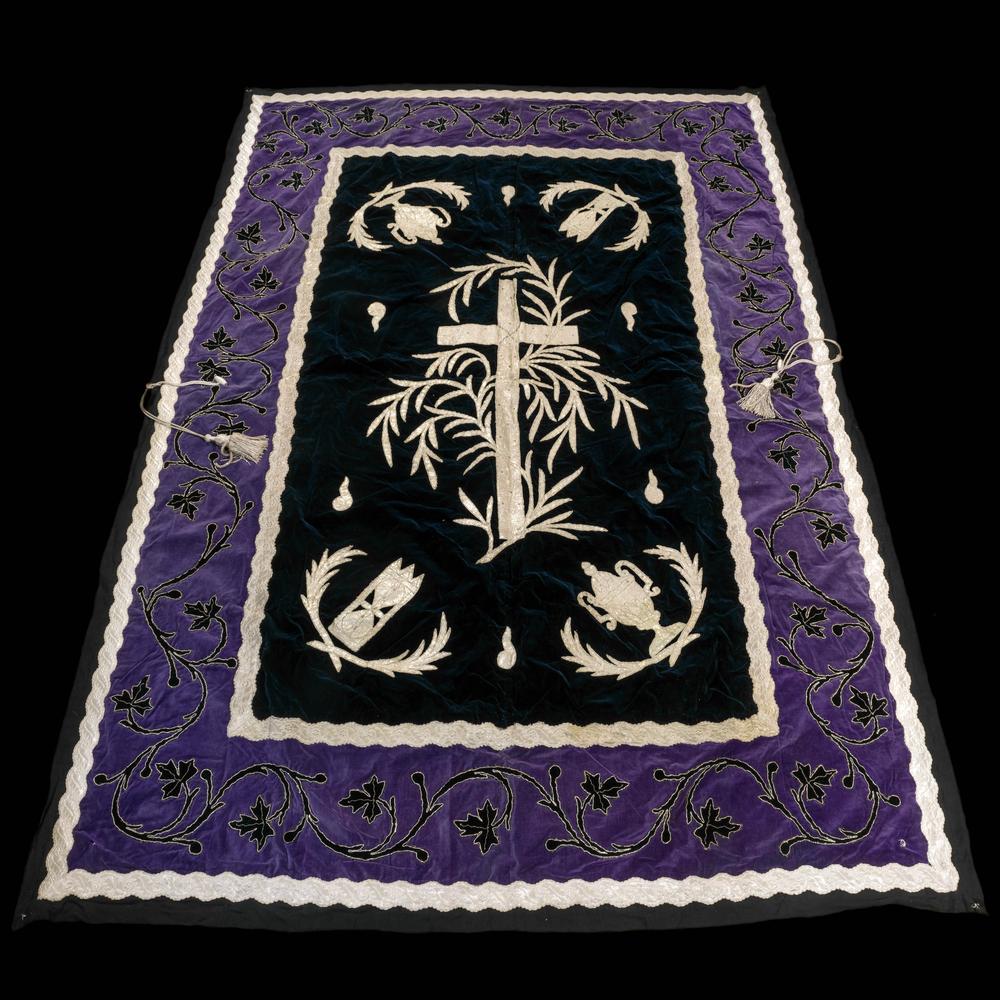
Rare and remarkable 19th-century funeral pall, created to physically accompany the deceased during solemn funeral rites. This type of liturgical textile — also referred to as a funeral pall — was placed over the coffin during the final office, giving the object a ritual, symbolic, and memorial dimension of great intensity.
This funeral cloth testifies to high-quality textile craftsmanship, characteristic of careful 19th-century liturgical workshops.
It is made of thick black and purple velvet, carefully assembled, with a heavy and regular drape indicating a piece conceived for solemn ceremonial use. The applied embroideries, executed by hand, display a balanced and controlled composition using light and silver threads, combined with fine braids and lace trimmings.
The fastening cords and the peripheral finishing confirm a functional conception, intended to be placed and secured upon a coffin during funeral services, rather than serving as a purely decorative textile.
The central composition develops a coherent and learned funerary iconographic program, directly derived from the Christian tradition of the memento mori.
Among the elements that can be distinguished are:
-
a central cross, affirming Christ’s victory over death and the hope of resurrection;
-
hourglasses, explicit symbols of the passage of earthly time and of human finitude, framed by stylized vegetal scrolls, traditional ornamental motifs evoking continuity, rebirth, and divine order;
-
funerary urns, a direct reminder of bodily death and of the common destiny of mankind;
-
motifs of tears, branches, and wreaths, associated with mourning, penitence, but also with spiritual triumph and eternal life.
The association of black, the color of mourning and death, and purple, the liturgical color of penitence and expectation, reinforces the gravity and symbolic depth of the whole.
This funeral pall was used during solemn funerals, possibly within the context of a confraternity, a private chapel, or for notable families. These textiles, often reused but rarely preserved, have largely disappeared, which explains the rarity of such surviving examples today, particularly when they display such complete and readable iconography.
Unlike altar frontals, this piece was not intended for permanent display, but for direct ritual use, in contact with the coffin of the deceased.
Condition
Good overall state of preservation, with old wear consistent with genuine funerary use.
Velvet well preserved, embroideries intact, with an authentic and homogeneous patina.
A small tear should be noted in the lining on the non-visible side.
Interest
A rare piece of 19th-century funerary textile, of high craftsmanship and strong symbolic power. This funeral pall would naturally find its place within a demanding collection devoted to funerary rites, memento mori, or historic religious art, as well as within a museum context or a carefully curated cabinet of curiosities.
Period : 1840–1880
Dimensions : 240 × 170 cm
Size: 94" × 67"
The memento mori
The symbolism developed on this funeral cloth belongs fully to the Christian tradition of the memento mori, literally “remember that you must die.” Far from being a merely macabre reminder, the concept refers to a spiritual meditation on the brevity of earthly life and on the necessity of preparing for eternal life.
The hourglasses depicted recall the irreversible passage of human time, while the funerary urns evoke the reality of bodily death. These motifs, associated with the cross, do not express a despairing vision of death but rather a theological reading in which human finitude finds its meaning in the hope of resurrection.
In the context of 19th-century Catholic funerals, this visual language invited the living to inner reflection: the death of the deceased became a silent reminder of the human condition and a call to conversion, prayer, and remembrance. Understood in this way, the memento mori transcends simple funerary iconography and becomes a genuine instrument of spiritual meditation, inscribed in the very material of the object.