FRANCISCAN RELIQUARY CENTERED ON THE RELIC OF THE HOLY CRIB
FRANCISCAN RELIQUARY CENTERED ON THE RELIC OF THE HOLY CRIB
Our prices are in euros, the prices converted in dollars or other currencies can vary according to the rate.
Free shipping – fast and secure delivery.
ref: #RK00-920Couldn't load pickup availability
Important oval paperolle reliquary – Franciscan ensemble centered on the relic of the Crib of Christ, with seals of the canons of Saint-André of Bordeaux – 19th century
Important large-sized oval reliquary, presented in its original blackened wooden frame with convex glass. Through the richness of its composition and the quality of its execution, it belongs to the category of major devotional reliquaries, intended for a private oratory, a domestic chapel, or a conventual setting.
The interior composition, executed in finely crafted gilt paperolles, is arranged in a radiant structure around a clearly defined theological center: the relic of the Crib of Our Lord.
The red silk background, the color of sacrifice and the Passion, creates a striking contrast with the gilded elements and enhances each relic, arranged according to a perfectly legible hierarchy.
A reliquary centered on the mystery of the Incarnation
The heart of the reliquary is occupied by:
“From the Crib of Our Lord”
Relic directly associated with the Nativity of Christ
This central position is not decorative but doctrinal:
it establishes the Incarnation as the anchor point of the entire composition.
This choice is deeply connected to the spirituality of Saint Francis of Assisi, who was the first to popularize the living Nativity scene, giving the birth of Christ a central place in Christian devotion.
A Franciscan coherence structured around the Crib
Around this central relic unfolds a remarkably coherent ensemble, largely oriented toward Saint Francis and his spiritual universe, as a natural extension of the mystery of the Nativity.
Identification of the relics (10 relics):
“De la crèche de N.S.”
→ From the Crib of Our Lord
Translation: Relic associated with the crib of Christ, referring to the place of the Nativity in Bethlehem and to the mystery of the Incarnation.
“F. du rosier miraculeux de St François”
→ Leaf of the miraculous rosebush of Saint Francis
Translation: Botanical fragment linked to the miraculous rosebush of Assisi, associated with a hagiographic episode of Saint Francis symbolizing purity and victory over temptation.
“De la chasuble de St François”
→ From the chasuble of Saint Francis
Translation: Textile fragment from a liturgical garment attributed to Saint Francis of Assisi, bearing witness to the material reality of the saint’s life.
“Sous la chaire d’où St François publia l’indulgence de la Portioncule”
→ Under the pulpit from which Saint Francis proclaimed the indulgence of the Portiuncula
Translation: Fragment linked to one of the major sites of the Franciscan tradition in Assisi, associated with the proclamation of the so-called Portiuncula indulgence, a central event in the history of the Order.
“De la porte de l’infirmerie du couvent de St François”
→ From the door of the infirmary of the convent of Saint Francis
Translation: Fragment of an architectural element linked to a place of care within a Franciscan convent, evoking the dimension of charity and assistance proper to the Order.
“St Jean de la Croix”
→ Saint John of the Cross
Translation: Relic attributed to the 16th-century Carmelite mystic, a major figure of contemplative spirituality and the theology of divine union.
“Bse Marguerite Marie”
→ Blessed Margaret Mary
Translation: Relic of Margaret Mary Alacoque, a Visitandine nun associated with the spread of devotion to the Sacred Heart in the 17th century.
“De la pierre où s’est assise N.D. de la Salette”
→ From the stone on which Our Lady of La Salette sat
Translation: Fragment associated with the site of the Marian apparition of La Salette (1846), referring to a 19th-century devotion centered on penance and conversion.
“St Thérèse”
→ Saint Teresa
Translation: Relic attributed to a saint bearing this name; the precise identification remains uncertain (possibly Teresa of Ávila or Thérèse of Lisieux depending on the context of the reliquary’s composition).
“Agnus Dei”
→ Agnus Dei
Translation: Fragment of pontifically blessed wax, traditionally consecrated in Rome and reputed for its protective virtues against physical and spiritual dangers.
The reverse
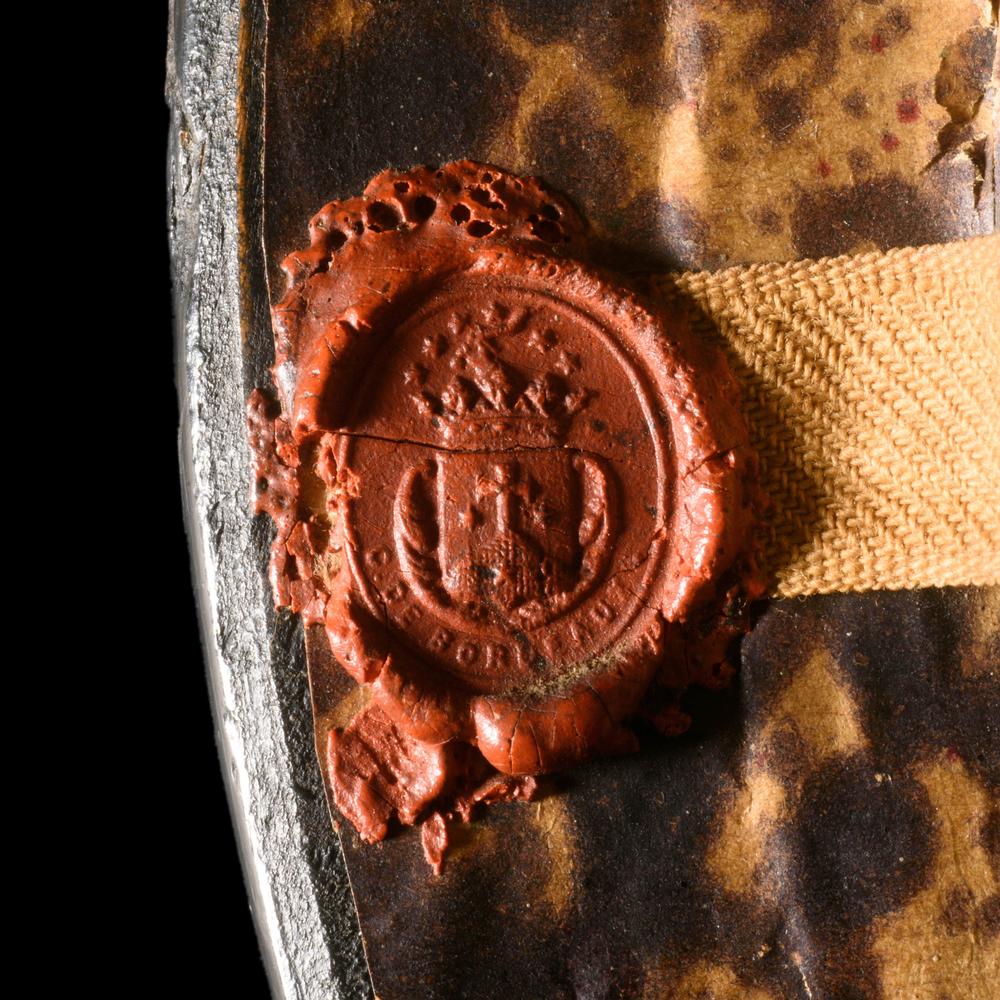
The reverse is closed by an old mounting in marbled paper, held by crossed textile ribbons and sealed with several red wax seals.
These seals bear the arms of the canons of the cathedral of Saint-André in Bordeaux, attesting to official ecclesiastical authentication and guaranteeing the integrity of the reliquary since its assembly
PERIOD : 19th century
DIMENSIONS : 22 cm × 18 cm
SIZE : 8.7" × 7"
This reliquary stands out for a particularly clear and theologically powerful construction:
everything converges toward the central relic of the Crib of Christ, the true spiritual heart of the ensemble.
Around this incarnate source of the Christian mystery is organized a network of Franciscan relics directly linked to Saint Francis — a figure who, historically and spiritually, gave the Nativity an essential place in Christian devotion.
The elements linked to Assisi (Portiuncula, rosebush, conventual objects, the saint’s garment) are not merely juxtaposed: they extend the mystery of the Crib into the life of the saint, as a living imitation of the poor and incarnate Christ.
The mystical figures (John of the Cross, Margaret Mary), as well as the Marian presence (La Salette), enrich this structure without altering its coherence, situating the object within a spirituality of the heart, contemplation, and penance.
The fragment of Agnus Dei ultimately connects this devotion to the universal Church, introducing a protective and sacramental dimension.
The whole thus constitutes an exceptional reliquary through its internal coherence, entirely constructed around the mystery of the Incarnation, interpreted through the prism of Franciscan spirituality.