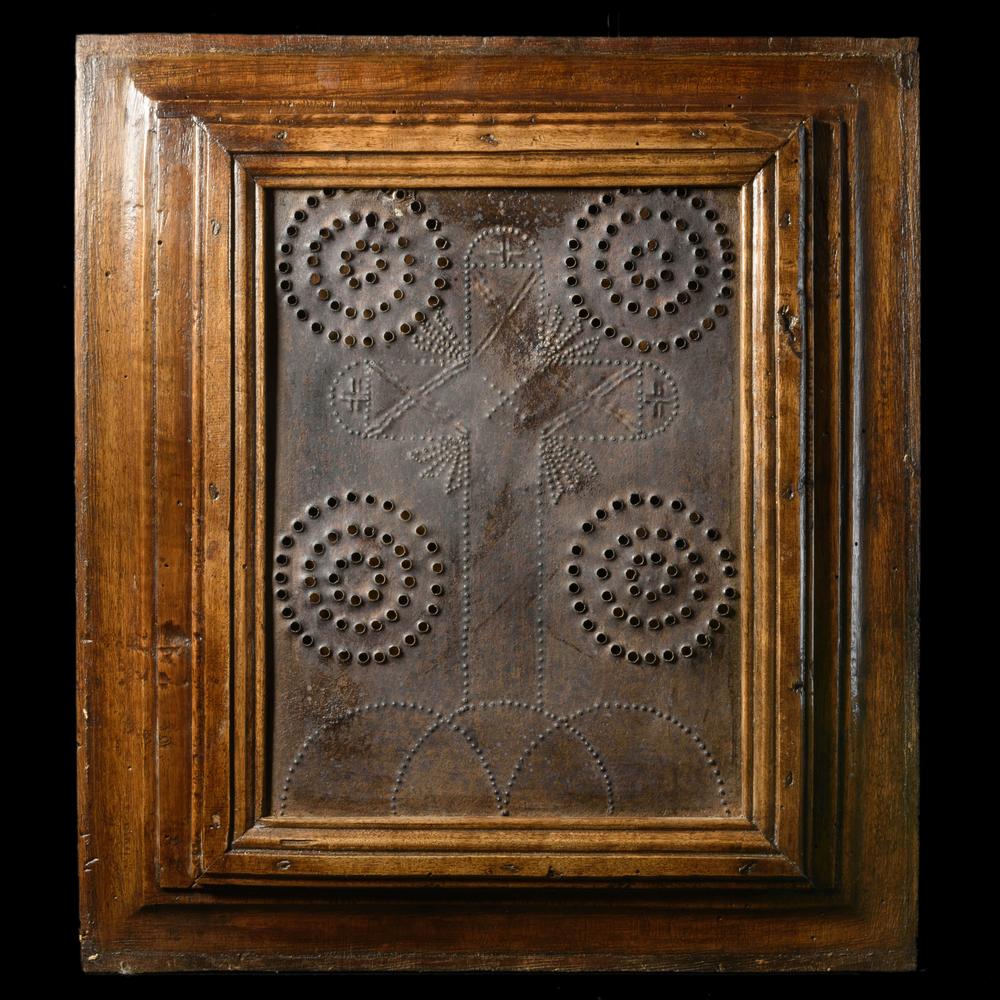
EXTREMELY RARE CONFESSIONAL GRILLE
SOLD — This object is now part of a private collection
EXTREMELY RARE CONFESSIONAL GRILLE
Our prices are in euros, the prices converted in dollars or other currencies can vary according to the rate.
Free shipping – fast and secure delivery.
ref: #RK00-937Couldn't load pickup availability
Of dark and intensely evocative presence, this antique confessional grille belongs to those religious objects now almost vanished, material witnesses to intimate and silent spiritual practices. Designed to establish a sacramental separation during the administration of the sacrament of penance, it materialized an invisible space where confession, absolution, and secrecy were bound together.
Its solid wood frame, of deliberately simple and archaic construction, encloses a perforated metal plate forming a stylized cross surrounded by primitive spiral motifs. Behind this austere grille, whispered exchanges took place, in dim light and under the restraint imposed by religious discipline. The object directly evokes the spiritual tension inherent to the moment of confession, a symbolic boundary between revealed fault and granted forgiveness.
Intended for concrete and repeated use, this type of utilitarian device has almost completely disappeared with the evolution of liturgical practices. The surviving examples are now extremely rare, most having been destroyed, repurposed, or simply lost over time. The survival of such an early confessional panel thus constitutes an exceptional testimony to the discreet and sometimes rudimentary forms of religious life of the past.
Through its primitive carpentry, the simplicity of its ironwork, and its deeply aged patina, this piece can be confidently dated between the late 17th century and the very early 18th century.
An object charged with mystery and memory, almost unsettling in its sobriety, this confessional panel represents a major religious curiosity — a rare and powerful piece intended for collectors of early spiritual objects and cabinets of curiosities.
PERIOD : late 17th / early 18th century
DIMENSIONS : 44 cm × 40 cm
SIZE : 17.3" × 15.7"
Confessionals gradually appear in Christian history when the confession of sins leaves the public sphere to become an intimate, almost secret act. As individual confession becomes established, the Church introduces devices intended to preserve ritual distance between priest and penitent. From the Renaissance onward, these structures take on a recognizable form: enclosed spaces, often narrow and dark, where speech becomes a whisper and conscience confronts itself.
In the dimness of these silent-laden places, confessionals become true spiritual theatres. Behind a pierced grille or in the shadow of a wooden panel, confessions are exchanged in low voices, carrying anxiety, contrition, and hope. These objects, shaped for a sacred yet profoundly human function, retain today a singular, almost unsettling aura. They seem to preserve the invisible memory of confessed sins, entrusted secrets, and granted absolutions.
Over time, confessionals have acquired a dimension that goes beyond their simple liturgical role. Having become material symbols of guilt, forgiveness, and redemption, they fascinate as much as they intrigue. Discreet survivors of an intense and sometimes austere spirituality, they now occupy a privileged place in collections of antique religious objects and cabinets of curiosities, where their presence continues to evoke the mystery of human conscience and the timeless quest for inner peace.