DAGGER OF THE DAMNED – 19TH CENTURY
SOLD — This object is now part of a private collection
DAGGER OF THE DAMNED – 19TH CENTURY
Our prices are in euros, the prices converted in dollars or other currencies can vary according to the rate.
Free shipping – fast and secure delivery.
ref: #RK00-843Couldn't load pickup availability
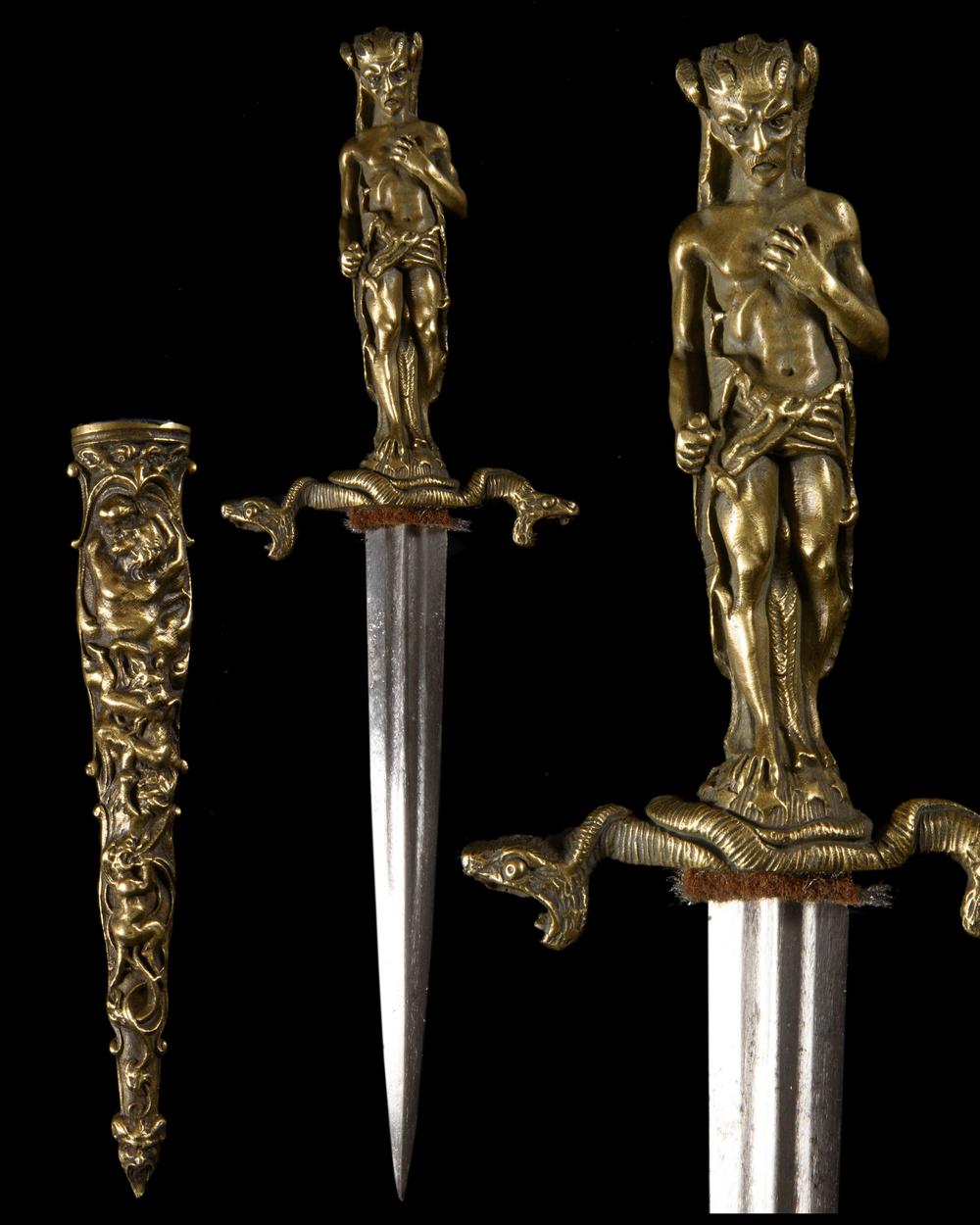
Ritual dagger in bronze and steel, deeply marked by demonic iconography. The pommel depicts a horned demon, with an expressive and unsettling face, standing in a hieratic posture, hand on the chest, as guardian or intermediary between the world of men and that of spirits. The guard, formed by two opposing serpents with open jaws, embodies the duality of forbidden knowledge, a universal symbol of temptation and occult power.
The scabbard constitutes a true journey towards Hell: it unfolds a dramatic scene where the damned and demons intertwine in a hopeless struggle. The naked bodies plunged downward evoke the fall of souls, entwined by monstrous and hybrid creatures. At the extremity, a grimacing mask sticking out its tongue represents the mouth of Hell, a devouring mouth swallowing the condemned.
The blade, straight, with a diamond-shaped cross-section, tapered to a point, equipped with two edges, a double fuller and a central ridge, continues this symbolic language: it channels the energy of the object, a true ritual instrument intended to accompany occult practices and ceremonies.
By its decoration, this dagger illustrates the confrontation between infernal and human forces, between damnation and power, and embodies the role of the weapon as a vector of passage, domination and invocation. It stands out as an exceptional piece, at the crossroads of esotericism, art and ritual.
PERIOD : XIX century
TOTAL LENGTH : 24cm / 9.5"
BLADE LENGTH : 12cm / 4.7"
The origins of occult weapons go back to the earliest beliefs of humanity. It is common to find, among pre-Columbian civilizations as well as among the Shang, ritual knives fashioned from flint, gold or jade. The Gallic warriors, led by Vercingetorix, attributed to their swords the power to capture the vital energy of their victims by soaking them in their blood, thus transforming them into “animated” objects. During the Middle Ages, witches used the arthame, a magical knife, to perform mysterious operations. The importance of mysterious daggers persisted even during the Romantic period, when they were used in initiation rituals of secret societies and during dark ceremonies of black masses, thus preserving their significant role up to the present day.