RARE ANATOMICAL CAST: CYCLOPEAN FETUS, 19TH CENTURY
RARE ANATOMICAL CAST: CYCLOPEAN FETUS, 19TH CENTURY
Our prices are in euros, the prices converted in dollars or other currencies can vary according to the rate.
Free shipping – fast and secure delivery.
ref: #RK00-846Couldn't load pickup availability
Rare medical plaster cast with patinated surface depicting a cyclopean fetus affected by a severe cranial malformation, an emblematic object of 19th-century teratology. Entirely covered with its original white workshop preparation, it reproduces with striking accuracy an authentic case of cyclopia, resulting from alobar holoprosencephaly, one of the most dramatic and feared anomalies in the history of medicine. The profoundly altered cranial volumes bear witness to the so-called “cyclopean skull” deformity, while the absence of facial differentiation gives the whole a presence that is both unsettling and powerful. This type of cast, made directly from a real subject, constituted a first-rate pedagogical tool in medical faculties, anatomical cabinets, and hospital collections where students were taught the major categories of congenital malformations.
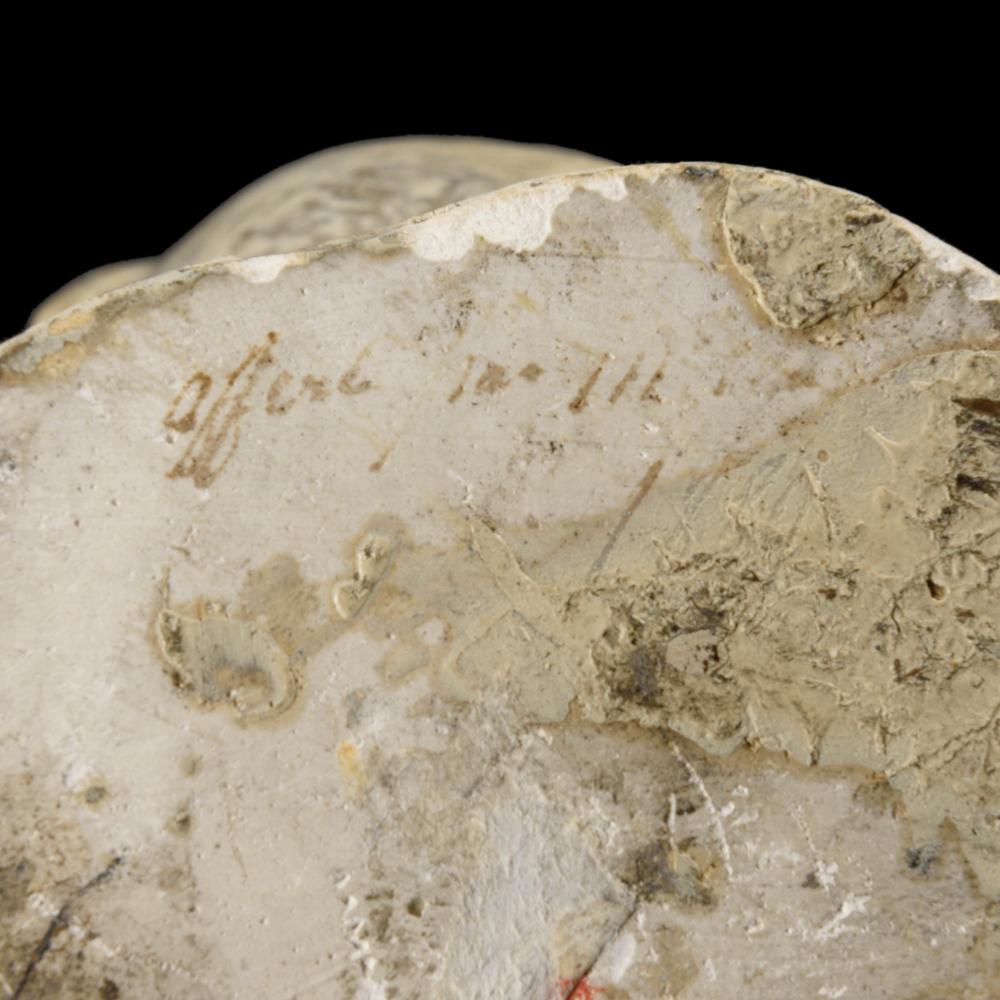
The piece is in a remarkable state of preservation for an object of this nature and age, retaining its entire original patina as well as the characteristic traces of workshop handling. On the reverse, period handwritten annotations and a red inventory number add an essential museological dimension, confirming its inclusion in a study collection and reinforcing its scientific authenticity. Casts of this type were produced only in very small numbers, each example being unique by the very nature of the subject molded. Many specimens disappeared during the hospital reforms of the 20th century or were destroyed when teratology ceased to be taught visually, making surviving examples particularly sought after by collectors of medical curiosa and museum institutions.
19th-century casts of cyclopean fetuses are of great rarity, both because of the low clinical incidence of this extreme pathology and because of evolving ethical and scientific standards that brought the production of such models to an end. The examples that survive today are for the most part preserved in a few prestigious collections, such as the Musée Dupuytren in Paris or the major European cabinets of pathological anatomy. The piece presented here belongs to this historical tradition: a direct testimony to former teaching methods, at the crossroads of science, the history of medicine, and the cabinet of curiosities.
PERIOD : 19th century
DIMENSIONS : 14 cm × 14 cm
SIZE : 5.5" × 5.5"
Fetal cyclopia, described as early as Antiquity, fascinated physicians, philosophers, and naturalists for centuries. Long interpreted as a prodigious or supernatural manifestation, it was only understood with the advances of modern embryology, which revealed it to be the most severe form of holoprosencephaly, in which the forebrain fails to divide into two hemispheres. Affected subjects present a single ocular opening, an almost complete absence of the nasal cavity, and cranial deformities incompatible with life. Casts such as this allowed students to grasp the morphological characteristics of these rare anomalies without resorting to fluid-preserved specimens, offering a direct, durable, and manipulable visual approach. These fragile and highly specialized objects now constitute irreplaceable witnesses to the history of medicine—testimonies to an era in which observation of reality was the key to learning.