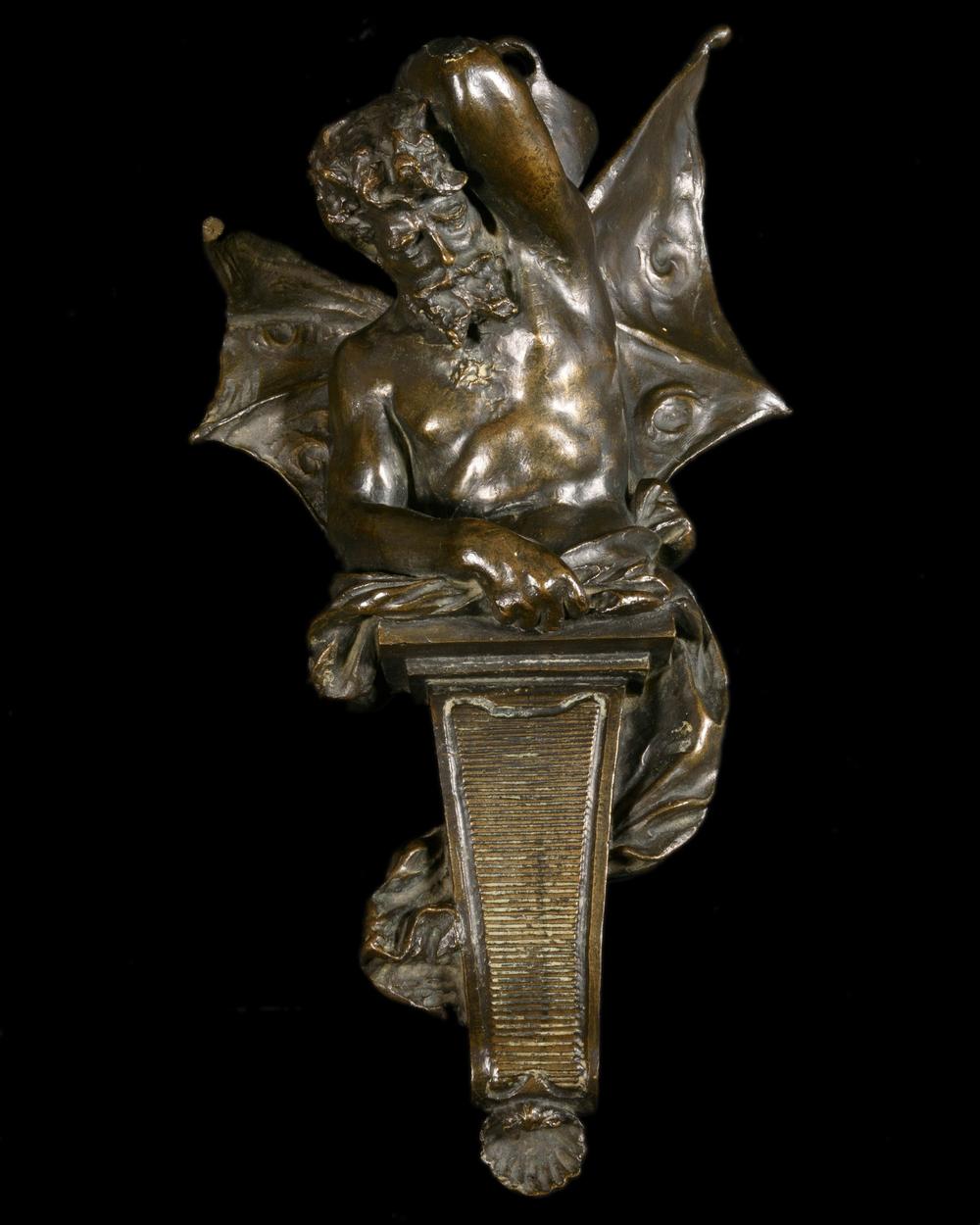
WALL CONSOLE IN BRONZE DEPICTING A WINGED DEMON
SOLD — This object is now part of a private collection
WALL CONSOLE IN BRONZE DEPICTING A WINGED DEMON
Our prices are in euros, the prices converted in dollars or other currencies can vary according to the rate.
Free shipping – fast and secure delivery.
ref: #RK00-785Couldn't load pickup availability
Brown-patinated bronze, 19th century, Grand Tour production.
This decorative console represents a bearded, horned demon, sculpted in high relief and integrated into an architectural structure. The figure, with a powerful bare torso, projects forward in a dramatic posture. His left arm, bent behind his head, supports a metal cauldron, while his right arm rests on the molded cornice that forms the top of the console.
His face, framed by thick locks and a full beard, is topped with two short, curved horns, accentuating his infernal nature. The membranous wings, widely spread, extend on either side of the body and reinforce the tension of the composition. A tight drapery surrounds his hips and falls in nervous folds. The lower part of the support, fluted and elongated, ends in a stylized shell.
The tormented expression, the vigor of the modeling, and the combination of demonic attributes (horns, bat wings, cauldron) recall the infernal imagery inherited from the Renaissance and the Baroque. However, the execution and patina place this work within the historicist production of the 19th century, conceived for the Grand Tour market. It illustrates the Romantic taste for fantastic and diabolical figures, destined to adorn scholarly interiors and to recall, through their theatricality, the evocative power of ancient and Baroque art.
PERIOD: 19th century
DIMENSIONS: 35 cm x 7 cm
SIZE: 13.8" x 1.2"