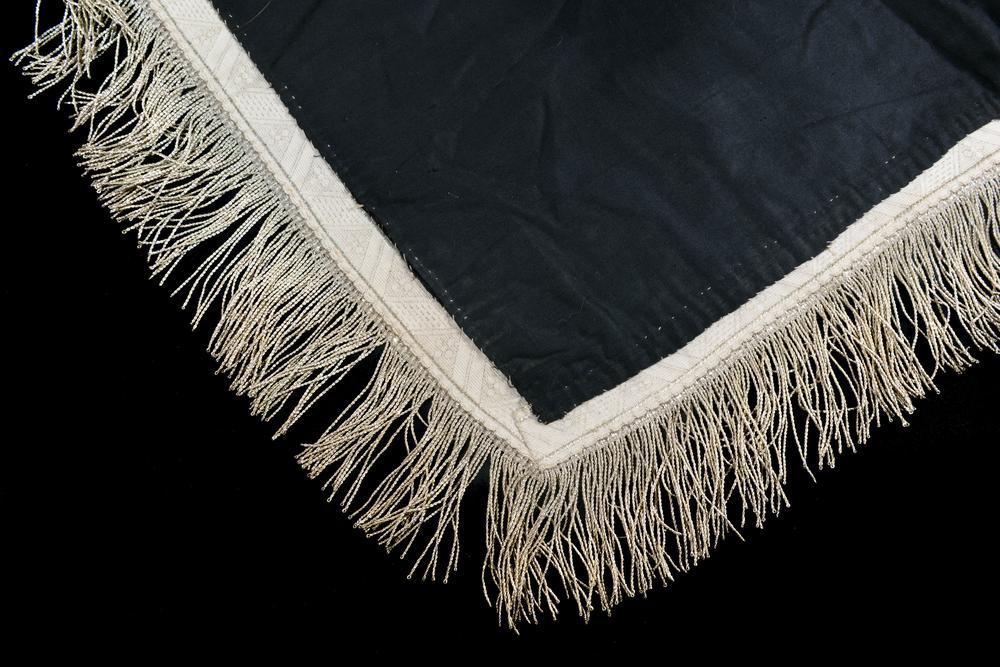
Black Velvet Funeral Pall – 19th Century
Black Velvet Funeral Pall – 19th Century
Our prices are in euros, the prices converted in dollars or other currencies can vary according to the rate.
Free shipping – fast and secure delivery.
ref: #RK00-979Couldn't load pickup availability
Black Velvet Funeral Pall with Silver Thread Embroidery and Fringes – 19th Century
France, circa 1850–1880
Rare and elegant 19th-century ceremonial funeral pall, also known as a coffin pall or coffin cover, intended to cover the coffin during religious services and funeral ceremonies.
Made of fine-quality black velvet, it is entirely embellished with hand-executed silver metal thread embroidery. The textile is framed by a wide woven braid, complemented by a spectacular silver metal thread fringe, preserved around its entire perimeter. An old lining completes this remarkable piece.
The composition is distinguished by its great elegance and refined simplicity. A large Latin cross, formed by delicate scrolling foliage, harmoniously structures the entire surface of the textile. The borders are richly decorated with foliage, stylised flowers and delicate scrolls, lending the composition a remarkable sense of lightness despite its funerary purpose.
At the centre of the composition is its principal religious emblem:
- a Crown of Thorns enclosing the three Nails of the Passion, symbolising the Crucifixion, Christ's redeeming sacrifice and the hope of the Resurrection;
- a continuous pattern of scrolling foliage, composed of intertwined leaves, flowers and stems, evoking the continuity of life, faithfulness and eternity;
- a deliberately restrained composition, favouring spiritual contemplation over an abundance of funerary symbols, conveying a profound sense of reverence and solemnity.
The detailed photographs reveal particularly fine craftsmanship. The embroidery is entirely executed in silver metal threads using several embroidery techniques, creating a design of remarkable delicacy. The richly woven peripheral braid and the wide original metallic fringe bear witness to the expertise of a workshop specialising in prestigious liturgical textiles.
Judging by the quality of its workmanship and the richness of its finishing details, this funeral pall was intended for important funeral ceremonies, probably within a parish, a religious confraternity or a family of high social standing.
Funeral palls of this quality have become increasingly rare. Many disappeared following the liturgical changes of the 20th century or through wear associated with their use. Examples retaining their complete metallic borders are now particularly sought after.
Condition
Very fine overall condition.
The velvet retains a beautiful depth of colour and an excellent overall appearance.
The silver thread embroidery remains remarkably fresh and clearly defined, with an attractive aged patina.
The wide woven braid and its original metallic fringe are exceptionally well preserved.
Only a few discreet traces of wax should be noted, consistent with its former liturgical use and in no way detracting from the overall presentation of the piece.
The old lining is also preserved.
Collector's Interest
A rare 19th-century funeral pall, remarkable for the delicacy of its silver thread embroidery, the elegance of its scrolling foliate composition and the preservation of its spectacular original metallic fringe.
Its deliberately restrained iconography, centred on the Crown of Thorns and the three Nails of the Passion, offers a particularly refined interpretation of Memento Mori, emphasising Christian contemplation and the hope of the Resurrection.
Examples retaining a complete metallic border of this quality are now among the most sought-after liturgical textiles. This piece would make a distinguished addition to a collection devoted to funerary rites, antique textiles or religious art, as well as to a refined cabinet of curiosities.
Period: circa 1850–1880
Dimensions: 250 × 150 cm
Size: 98.4" × 59.1"
The Memento Mori
At the centre of this composition is the Crown of Thorns enclosing the three Nails of the Passion, one of the most powerful emblems in Christian iconography. This symbol recalls Christ's sacrifice and affirms that death is not an end, but a passage towards the Resurrection.
Unlike other funeral palls richly adorned with hourglasses, urns or other emblems of Memento Mori, this example favours a more restrained and contemplative expression. The scrolling foliage extending across the textile evokes the continuity of life, while the black velvet recalls mourning and solemn reflection.
Through its balance and restraint, this piece beautifully illustrates the funerary spirituality of the 19th century, when the beauty of religious ornament accompanied prayer and invited the faithful to contemplate the Passion of Christ and the hope of eternal life.