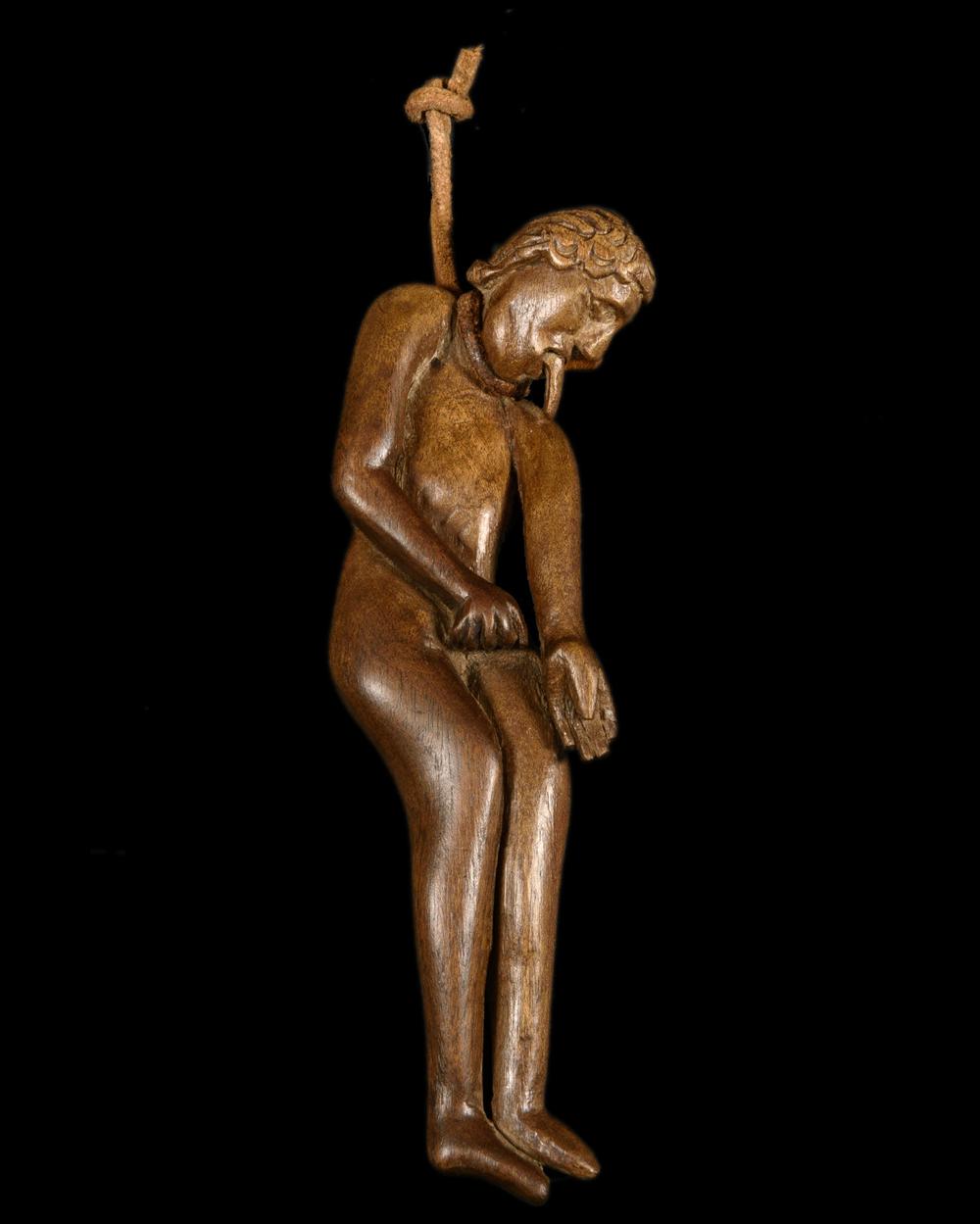
ANTIQUE FIGURINE OF A HANGED MAN
SOLD — This object is now part of a private collection
ANTIQUE FIGURINE OF A HANGED MAN
Our prices are in euros, the prices converted in dollars or other currencies can vary according to the rate.
Free shipping – fast and secure delivery.
ref: #RK00-797Couldn't load pickup availability
This wooden figurine represents a hanged man suspended by a rope tied around the neck. The naked body is carved in a simple yet expressive manner: the head tilted forward, the mouth slightly open revealing the swollen, protruding tongue, the arms pressed against the torso, and the hands resting on the thighs all convey the abandonment of the executed. The hair, rendered in thick and regular strands, gives the whole piece an archaic and unsettling appearance.
Through its bareness and raw realism, the object exudes a strange aura, both disturbing and enigmatic. Although its exact origin remains uncertain, it could belong to the taste of the 16th and 17th centuries for macabre and unusual representations, a time when imagery of death and punishment was particularly prevalent.
Outside traditional religious contexts, it is not impossible that it had an esoteric meaning, or that it was created in a context of magical practice or curse, the figure of the hanged man symbolically embodying punishment or death inflicted upon an enemy. Whatever its intended purpose, it stands out as a singular work, whose expressive power continues to fascinate.
PERIOD: 19th century or earlier (the leather rope is recent)
DIMENSIONS: 17 cm
SIZE: 6.7"
Anthropomorphic figurines used in magic and witchcraft are attested from Antiquity to the modern era.
Often fashioned from lead, wax, clay or wood, they served as material supports for rituals of cursing, submission or protection. Needles were stuck into them, they were bound with cords, or buried to channel an intention against a designated person. Nudity, frequently depicted, reinforced the idea of a vulnerable body, reduced to its symbolic essence. These effigies had no aesthetic value in themselves: their power lay in their supposed effectiveness.
In some cases, they were hung, burned or broken to materialize the spell cast. Their role was to act as intermediaries between the visible world and the occult powers invoked. Later turned into curiosity objects, these witnesses of ancient beliefs reveal the importance of the human image in magical practices.