IMPRESSIVE ANTIQUE BLACK PENITENT'S ROBE
IMPRESSIVE ANTIQUE BLACK PENITENT'S ROBE
Our prices are in euros, the prices converted in dollars or other currencies can vary according to the rate.
Free shipping – fast and secure delivery.
ref: #RK00-Couldn't load pickup availability
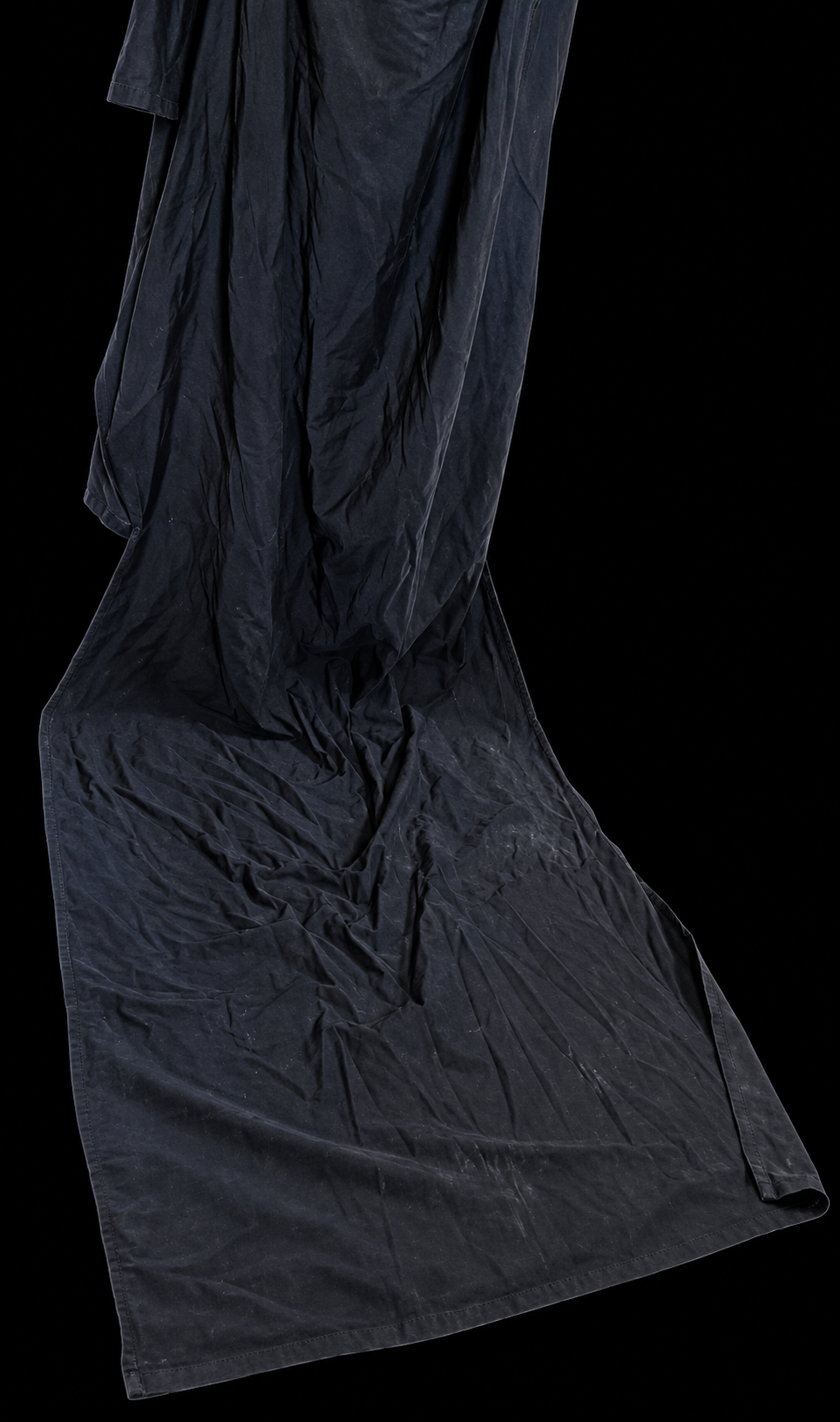
Exceptional and impressive black penitent's robe, consisting of a long processional gown and its imposing capirote with a tall conical point.
A magnificent antique ensemble, entirely made from thick black fabric, displaying fine craftsmanship and signs of wear that testify to its age.
Particularly spectacular in its dimensions and austere appearance, this garment belongs to the tradition of the penitential brotherhoods, whose religious processions, especially those held during Holy Week, are closely associated with the suffering, penance and death of Christ.
The black colour, associated with mourning and death, gives this ensemble a particularly solemn character. The capirote, with its tall conical point and only two openings for the eyes, allowed the penitent to remain completely anonymous during religious ceremonies.
The long, generously cut robe features an opening at the neckline, fastened with fabric ties. The capirote is a separate piece and extends into a shoulder cape covering the shoulders.
Today, it is particularly rare to encounter antique penitents' garments preserved as a complete ensemble, with both their long processional robe and original capirote. As these two elements have often been separated or dispersed over time, the survival of such a complete ensemble represents an additional point of interest for collectors of antique religious textiles and historical curiosities.
A remarkable and particularly impressive collector's piece, bearing witness to the ancient religious and penitential practices of Europe.
The pointed hood was originally stiffened by an internal cardboard cone, which is now missing.
Very good condition. A 10 cm section of stitching has come undone at the pocket opening.
PERIOD: First half of the 20th century
The penitential brotherhoods originated in the religious movements of the Middle Ages. Their members gathered to practise prayer, charity and penance, sometimes in particularly rigorous forms.
Death occupied a central place in their traditions. The brotherhoods notably accompanied the deceased during funeral ceremonies, assisted the dying and took part in processions commemorating the Passion and crucifixion of Christ.
The wearing of long robes and hoods that completely concealed the face allowed penitents to preserve their anonymity, symbolising humility before God and equality in the face of death.
Black, the colour of mourning and penance, was particularly prominent in certain brotherhoods. These long processions of hooded figures, sometimes accompanied by crosses, candles and representations of the dead Christ, were among the most impressive religious ceremonies.
Historically, certain penitential movements also practised self-flagellation, voluntarily inflicting physical suffering upon themselves in order to atone for their sins and symbolically share in the suffering of Christ.
The capirote, this distinctive tall conical hood, is particularly associated with the ancient penitential traditions of Spain. It remains today one of the most recognisable elements of Holy Week processions.
In the Catalan regions, both in Spain and in southern France, these penitential traditions have their origins in the Middle Ages, a period during which numerous religious brotherhoods developed, devoted to prayer, penance and the commemoration of the Passion of Christ. Passed down from generation to generation over several centuries, these practices have profoundly shaped European religious history.
Today, these antique garments constitute remarkable testimonies to the history of religious brotherhoods, penitential rites and the place occupied by death in European Christian traditions.